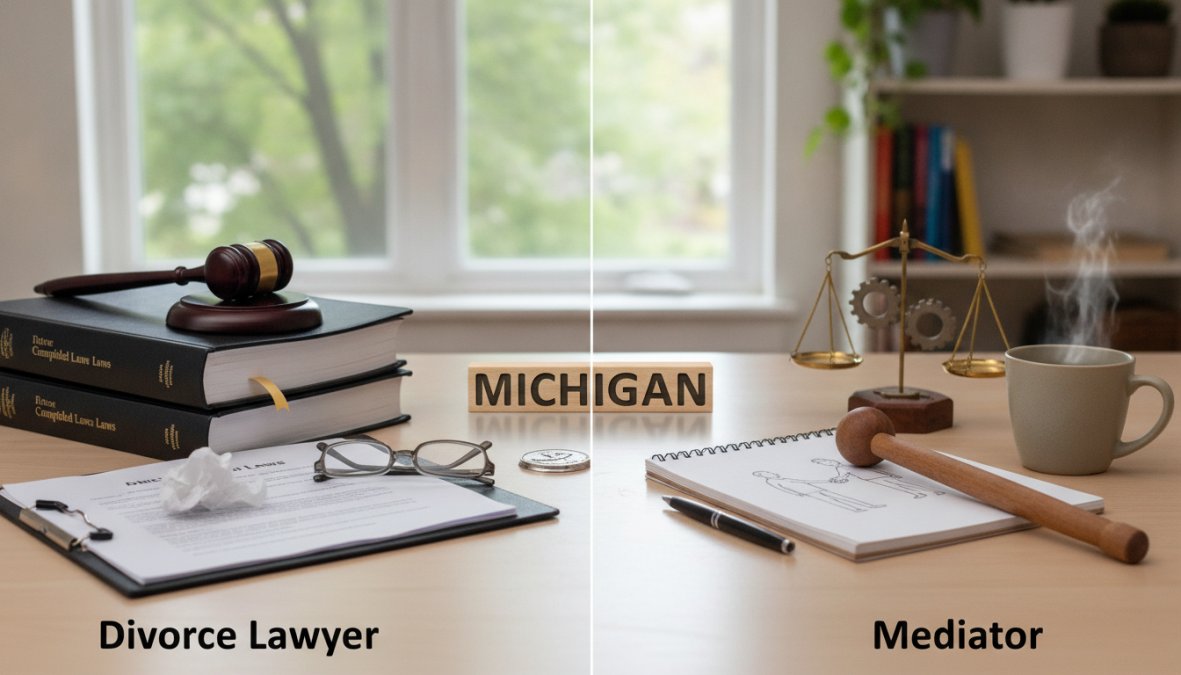
 comparison
Divorce Lawyer vs Mediator in Michigan: A Complete Comparison
Table of Contents
- What a Divorce Attorney Does
- What a Mediator Does
- Comparison Table: Lawyer vs Mediator
- Cost of Divorce Mediation in Michigan vs Legal Representation
- Michigan Divorce Mediation Process: How It Works
- Is Mediation Legally Binding in Michigan?
- When to Choose a Lawyer Over a Mediator in Michigan
- The Hybrid Approach: Mediation Plus Consulting Attorneys
- Pros and Cons: Lawyers vs Mediators
- Frequently Asked Questions
Last Updated: July 14, 2026
When facing a divorce in Michigan, choosing between a divorce lawyer and a mediator fundamentally shapes how your case unfolds, what you'll pay, and your final outcome. This decision affects property division, custody arrangements, support obligations, and your financial future. Understanding these differences upfront can save you thousands of dollars and months of unnecessary conflict.
What a Divorce Attorney Does
A divorce attorney is a legal advocate who protects your rights throughout the divorce process. In Michigan, divorce lawyers provide legal advice, represent you in court, draft legal documents, and ensure compliance with Michigan Court Rules and state family law statutes. They handle property division, spousal support, child custody and parenting time, child support calculations, and enforcement of court orders. Attorneys file motions, appear in court on your behalf, cross-examine witnesses, and present evidence to a judge if your case goes to trial. Critically, they provide legal advice, explaining your rights under Michigan law, assessing your position's strength, and counseling you on settlement offers.
What a Mediator Does
A mediator is a neutral third-party professional trained in conflict resolution who helps divorcing couples reach their own settlement agreement. Unlike a judge, a mediator doesn't make decisions. Unlike a lawyer, a mediator doesn't provide legal advice or represent either party. The mediator facilitates communication, helps both parties understand each other's interests, explores options, and guides them toward a mutually acceptable settlement. Mediation is confidential, communications made during mediation are generally inadmissible in court, which encourages honest dialogue without fear that statements will be used against you later.
Comparison Table: Lawyer vs Mediator
| Aspect | Divorce Attorney | Mediator |
|---|---|---|
| Role | Legal advocate for one party | Neutral facilitator for both parties |
| Legal Advice | Provides legal counsel and strategy | Cannot provide legal advice |
| Court Representation | Represents you in court proceedings | Does not represent either party in court |
| Cost Model | Hourly rate or retainer fee | Hourly rate (split between parties) or sliding scale |
| Confidentiality | Attorney-client privilege | Mediation confidentiality (communications inadmissible) |
| Decision Authority | You decide; lawyer advises | You and your spouse decide together |
| Best For | High-conflict cases, complex assets, custody disputes | Amicable separations, couples who can communicate |
| Timeline | Varies; litigation can take 12-24+ months | Often 3-6 months for resolution |

Cost of Divorce Mediation in Michigan vs Legal Representation
Cost is often the deciding factor. Mediation is generally more affordable. Mediators typically charge hourly rates with the cost split between both parties. A straightforward uncontested divorce might require 10-20 hours of mediation time spread across several months. Many Michigan counties offer court-sponsored mediation programs that are free or low-cost. The Michigan courts' ADR resources provide information on county-specific mediation services.
Divorce attorneys work on hourly or retainer fee models. An uncontested divorce with minimal assets might cost several thousand dollars. A contested case involving property disputes or custody battles can easily exceed ten thousand dollars or more. The longer your case stays in litigation, the more you pay.
Michigan Divorce Mediation Process: How It Works
Mediation in Michigan typically follows a structured path. Step 1: Initial Consultation and Agreement. You and your spouse meet with the mediator to discuss the process, establish ground rules, and sign a mediation agreement. Step 2: Information Exchange. Both parties disclose financial information, income, assets, and debts. Step 3: Identifying Issues and Interests. The mediator helps each party articulate what matters most to them. Step 4: Negotiation and Option Development. The mediator facilitates discussion about possible solutions. Step 5: Agreement and Drafting. Once the parties reach tentative agreement, the mediator helps draft a settlement agreement. Step 6: Legal Review and Finalization. Before signing, each party should have the agreement reviewed by a divorce attorney to ensure it's fair and complies with Michigan law.
Mediation confidentiality is a legal protection that encourages candid discussion. In Michigan, communications made during mediation are generally inadmissible in court. However, this protection does not apply to abuse, threats, or illegal conduct.
Is Mediation Legally Binding in Michigan?
Mediation itself is not binding, but the settlement agreement reached through mediation becomes legally binding once both parties sign it and a judge approves it. When you and your spouse reach agreement through mediation, that agreement is drafted as a "Mediated Settlement Agreement" or incorporated into a formal "Judgment of Divorce." Once signed by both parties, the agreement is enforceable. Michigan courts will review the agreement for compliance with Michigan law, ensuring that child support follows the statutory formula, custody arrangements serve the children's best interests, and property division is reasonable. Once approved, the settlement agreement becomes a court order.
When to Choose a Lawyer Over a Mediator in Michigan
Not every divorce is suitable for mediation. If your spouse is hostile, refuses to cooperate, or uses intimidation, mediation is unlikely to work. Mediation requires both parties to negotiate in good faith. If your spouse has a history of abuse, mediation may not be safe.
Divorces involving significant assets, business ownership, investment portfolios, or real estate require careful analysis. A divorce attorney can identify hidden assets, value complex property, and ensure you receive a fair share under Michigan's equitable distribution rules.
When parents cannot agree on custody and parenting time, litigation may be necessary. Michigan courts apply the "best interests of the child" standard. A divorce attorney can present evidence, call witnesses, and argue why your proposed custody arrangement serves the children's best interests.
The Hybrid Approach: Mediation Plus Consulting Attorneys
Many Michigan couples use a hybrid model: mediation with consulting attorneys. Each party hires a lawyer for limited-scope advice rather than full representation. Before mediation, the attorney reviews your situation and explains your rights. During mediation, you apply that knowledge to negotiate effectively. After reaching tentative agreement, the attorney reviews the settlement to ensure it's fair and legally sound. This limited-scope representation costs significantly less than full litigation representation because the attorney isn't attending every mediation session or preparing for trial.
Michigan Court Rule 3.216 governs mediation in family law cases. The rule allows courts to order mediation before trial and establishes standards for mediators, confidentiality, and the mediation process. Under MCR 3.216, mediators must be qualified, typically attorneys, social workers, or other professionals with training in family law and mediation.
Pros and Cons: Lawyers vs Mediators
A divorce attorney provides legal expertise, advocacy, and protection. Your lawyer knows Michigan family law, understands how judges in your county typically rule, and can predict likely outcomes. For high-conflict cases, custody disputes, or complex property division, an attorney is often essential.
The primary disadvantage of full legal representation is cost. Additionally, litigation is adversarial and takes time, cases often take 12-24 months or longer to resolve. Litigation outcomes are also unpredictable; judges have discretion in many family law decisions.
Mediation is cost-effective and faster. Most mediated divorces are finalized within 3-6 months. Mediation preserves relationships, important if you have children and will co-parent for decades. Mediation also gives you control; you and your spouse decide the outcome, not a judge. You can craft creative solutions that work for your family, and settlement discussions remain confidential.
However, mediators cannot provide legal advice. If you're unsure whether a proposed settlement is fair, a mediator cannot tell you. Mediation also requires cooperation; if your spouse is uncooperative, the process fails. Mediation is not suitable for abuse situations, and it cannot compel agreement.
Frequently Asked Questions
Is mediation mandatory for divorce in Michigan?
Michigan does not require mediation for all divorces, but courts may order it in contested cases. Under Michigan Court Rules (MCR 3.216), judges have discretion to refer parties to mediation, particularly in custody disputes. Uncontested divorces can proceed without mediation. However, attempting mediation first can reduce litigation costs and court stress, making it a practical choice even when not required.
How much does a divorce mediator cost in Michigan compared to a lawyer?
Mediation costs vary depending on the mediator's experience and case complexity. The Center for Mediation & Training offers sliding scale fees, and MI-Resolve provides free online mediation through the state. Divorce attorneys typically charge hourly rates or retainer fees, which accumulate faster in contested litigation. For specific pricing from Coppins Law Group, contact us for a free consultation to discuss your situation and receive an accurate estimate.
Can a mediator in Michigan provide legal advice?
No. Mediators are neutral third parties who facilitate discussion and help both spouses reach agreement, but they cannot provide individual legal advice. This is a key limitation, mediators won't advise you on property division strategy or custody rights. Many couples address this by consulting with a divorce attorney separately before or after mediation to ensure their interests are protected under Michigan family law.
What happens if we reach an agreement through mediation in Michigan?
A mediation settlement agreement is not automatically binding. Once both parties agree on terms, the agreement must be formalized into a settlement agreement and submitted to the court for approval. The judge reviews it to ensure it complies with Michigan law and protects any minor children's interests. Once approved, it becomes part of the divorce decree and is legally enforceable.
When should I choose a divorce lawyer over a mediator in Michigan?
Choose a lawyer when your case involves contested issues, high-conflict dynamics, complex asset division, or child custody disputes. Lawyers provide legal representation, protect your rights in court, and prepare for trial if settlement fails. Mediation works best for amicable, uncontested divorces where both parties cooperate. If your spouse is uncooperative or the case involves significant assets or parenting disputes, legal counsel is essential.