 how-to
How to Fight DUI Charges in Michigan: A Step-by-Step Guide
Table of Contents
- Understanding Michigan DUI vs OWI Laws
- Step 1: Gather Evidence and Document the Traffic Stop
- Step 2: Challenge Breathalyzer and Chemical Test Results
- Step 3: Understand OWI Penalties for First Offense
- Step 4: Hiring a Criminal Defense Attorney
- Step 5: Explore Plea Bargain and Pre-Trial Options
- How to Fight DUI Charges: Common Defense Strategies
- License Suspension, Post-Conviction Relief, and Expungement
- Frequently Asked Questions
Last Updated: August 11, 2026
Understanding Michigan DUI vs OWI Laws
In Michigan, the legal term is Operating While Intoxicated (OWI), not DUI. This distinction matters because it defines how the charge is prosecuted and what defenses apply. OWI is codified under MCL 257.625 and covers operating a vehicle while under the influence of alcohol, drugs, or both. You can be charged if your ability to operate a vehicle is materially and appreciably impaired by any substance, though a BAC of 0.08% or higher creates a legal presumption of impairment for drivers 21 and older.
Michigan recognizes three tiers of OWI charges, each with different penalties affecting licensing, sentencing, and post-conviction relief options. Michigan's implied consent law is critical: when you drive on Michigan roads, you've implicitly consented to chemical testing. Refusing a test carries separate penalties from the OWI charge itself. The zero tolerance law for drivers under 21 sets the BAC limit at 0.02%, far lower than the adult threshold.
Step 1: Gather Evidence and Document the Traffic Stop
The moment the traffic stop happens is when your defense begins. Most people focus on the breathalyzer or field sobriety test, but the legality of the stop itself is often where cases are won or lost.
Challenging the legality of the traffic stop
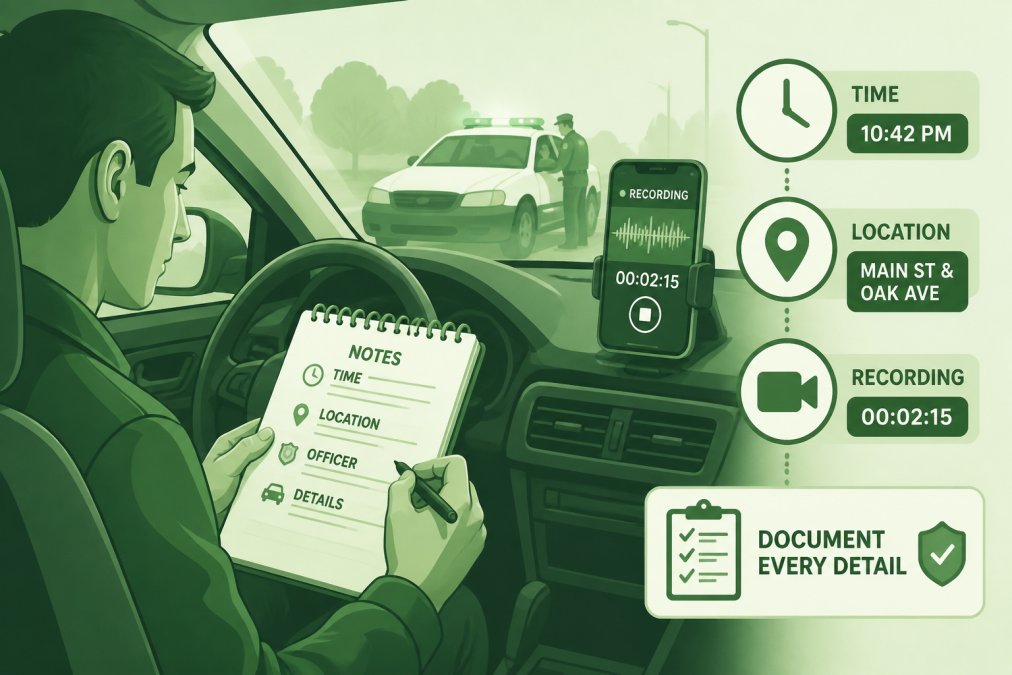
Police need reasonable suspicion to initiate a traffic stop. Weaving between lanes, a broken taillight, or expired registration can justify a stop, but it must be based on actual observation, not a hunch or profiling. Document everything immediately: time, location, weather, road conditions, and exactly what the officer said they observed. Ask the officer directly why they stopped you, their answer becomes part of the record.
Witness statements matter enormously. Get written accounts from anyone in your vehicle. Identify other drivers or pedestrians who witnessed the stop. Dashcam recordings from nearby vehicles or business security footage can corroborate your version and challenge the officer's narrative.
Documenting field sobriety test accuracy
Field sobriety tests are notoriously unreliable. The three standardized tests, horizontal gaze nystagmus, walk-and-turn, and one-leg stand, all have documented error rates. Environmental factors, medical conditions, age, and footwear affect performance. Document the conditions: uneven pavement, traffic distraction, darkness, illness, injury, or fatigue all impact test validity.
Request all dashcam footage from the police vehicle. This video is often the most objective evidence available, showing your demeanor, how clearly the officer gave instructions, and how you actually performed.
Step 2: Challenge Breathalyzer and Chemical Test Results
Breathalyzer machines and chemical tests require proper calibration, maintenance, and operator training. Request the maintenance records for the specific machine used in your case. Was it serviced on schedule? Are there documented calibration failures?
The operator's training and certification matter equally. Did the officer have valid certification? How recently was their training updated? Many officers administer breathalyzer tests without proper credentials, giving you grounds to challenge results.
The timing of the test is crucial. The legal requirement is that the test be administered as soon as reasonably possible after the stop. If there was significant delay, your BAC at the time of driving might have been lower than the test result, since alcohol absorption continues for 30 to 90 minutes after consumption.
Blood tests require a warrant in most circumstances. If you were tested without consent and without a warrant, the results should be suppressed. Even with a warrant, the chain of custody must be documented. Any break in the chain undermines reliability. Request an independent blood test if one wasn't performed, a second test can contradict the prosecution's results and raise reasonable doubt.
Step 3: Understand OWI Penalties for First Offense
A first OWI offense in Michigan carries mandatory penalties. For a BAC under 0.15%, jail time ranges from zero to 93 days, though many first-time offenders avoid jail through plea agreements or sentencing negotiations.
License suspension is mandatory for at least 30 days. You may be eligible for a restricted license allowing driving to work, school, or medical appointments, which requires an ignition interlock device. Fines range from $250 to $500, plus court costs and assessments. Mandatory alcohol education programs are required, which can include counseling, education classes, or inpatient treatment based on assessment results.
The criminal record carries long-term consequences affecting employment, housing, insurance, and professional licenses. This is why fighting the charge, rather than accepting a plea deal, is sometimes the better option.
Step 4: Hiring a Criminal Defense Attorney
An experienced criminal defense attorney who understands Michigan OWI law is essential. The attorney you hire should have specific experience with OWI cases, not just general criminal defense.

Coppins Law Group, PLLC brings trial-prepared criminal defense strategy and specialized DUI and OWI defense experience throughout Michigan. Their team offers steady guidance through a complex process.
During your initial consultation, bring all documentation from your stop and arrest. A thorough attorney will review everything and immediately identify weaknesses in the prosecution's case. Discuss fees upfront and understand what's included. Your attorney should explain your options clearly: proceed to trial, negotiate a plea agreement, or pursue a diversion program if available.
Step 5: Explore Plea Bargain and Pre-Trial Options
Not every case goes to trial. A plea bargain might involve pleading guilty to a lesser charge, avoiding a criminal conviction and its long-term consequences. Prosecutors sometimes offer reduced charges or penalties in exchange for a guilty plea because trials are expensive and unpredictable.
Get Your Free Consultation Now →
A pre-trial conference is a meeting with the prosecutor and judge to discuss the case without trial. Many cases are resolved at this stage because both sides get a realistic assessment of the other's position.
Diversion programs exist in some Michigan counties, allowing first-time offenders to avoid criminal conviction by completing specific requirements. Upon successful completion, the charge is dismissed. This is often the best outcome for a first offense, but eligibility varies by county and prosecutor discretion.
Request all discovery materials. Your attorney has the right to see everything the prosecution has: police reports, dashcam footage, breathalyzer maintenance records, witness statements, and other evidence. Weak evidence strengthens your negotiating position.
How to Fight DUI Charges: Common Defense Strategies
Several proven defense strategies apply to OWI cases in Michigan.
Challenging the traffic stop itself is often the strongest defense. If the initial stop was illegal, all evidence obtained after it can be suppressed through a motion to suppress, potentially ending the case before trial.
Attacking field sobriety test reliability works because these tests are subjective and error-prone. Expert witnesses can testify about test limitations and how environmental factors affect performance. Video evidence of your actual performance is powerful.
Challenging the breathalyzer requires understanding the machine's calibration history, operator training, and test timing. Blood test results can be challenged on chain-of-custody grounds or by requesting an independent test.
Medical explanations for impairment symptoms sometimes apply. Diabetes, neurological disorders, or inner ear problems can affect balance and coordination. Your attorney can present medical evidence to explain your appearance or test performance.
Challenging the officer's observations means examining whether the officer actually observed impairment or made assumptions. Swerving can result from a pothole. Slurred speech can result from fatigue. Bloodshot eyes can result from allergies. Your attorney forces the prosecution to prove impairment, not just point to symptoms with other explanations.
Witness testimony can be powerful. A passenger or witness testifying that you were not impaired creates reasonable doubt. A witness contradicting the officer's account undermines the prosecution's case.
License Suspension, Post-Conviction Relief, and Expungement
An OWI conviction triggers automatic license suspension, but Michigan law provides pathways to restore driving privileges. License suspension for a first offense is mandatory for at least 30 days. After that, you can apply for a restricted license allowing driving to work, school, and medical appointments, which requires an ignition interlock device.
The Driver Responsibility Act imposes additional fees on OWI convictions, assessed annually for three years, separate from fines and court costs.
Post-conviction relief is available if new evidence emerges that undermines your conviction. Expungement is the process of having your conviction removed from your record. In Michigan, OWI convictions can be expunged under certain conditions. A first offense is eligible for expungement after five years if you meet specific requirements: no other convictions, completion of all sentencing requirements, and payment of all fines and fees.
An arrest record can be expunged immediately if you were not convicted. If your case is dismissed or you're acquitted, you can petition for immediate expungement of the arrest record.
Consult with Coppins Law Group, PLLC about your specific situation. Their experience with post-conviction relief and expungement in Michigan means they understand the nuances of restoration and can guide you toward the best long-term outcome.
Facing an OWI charge in Michigan is overwhelming, but you have more options than you might realize. The evidence against you may be weaker than it appears, and the right defense strategy can change the outcome significantly. Coppins Law Group, PLLC offers free initial consultations to discuss your case, explain your legal options, and help you understand the path forward. With trial-prepared criminal defense strategy and specialized OWI expertise, they protect your rights, reduce legal penalties, and safeguard your driving privileges. Contact Coppins Law Group, PLLC today to get your free consultation and begin building your defense.
Frequently Asked Questions
What is the difference between a DUI and an OWI in Michigan?
Michigan uses the term Operating While Intoxicated (OWI) rather than DUI. OWI is the legal offense for driving with a blood alcohol content (BAC) of 0.08% or higher, or while impaired by drugs or alcohol. Understanding this distinction is crucial when fighting OWI charges, as the terminology affects how your case is prosecuted and defended in Michigan courts.
Can you challenge the results of a breathalyzer test?
Yes. Challenging breathalyzer results is a common defense strategy. Issues that can be challenged include improper calibration, operator error, maintenance records, and whether the test was administered according to protocol. An experienced criminal defense attorney can examine the testing equipment's history, the officer's qualifications, and procedural compliance to identify weaknesses in the prosecution's evidence.
What are the potential penalties for a first-offense OWI?
First-offense OWI penalties in Michigan typically include fines, license suspension through the Driver Responsibility Act, possible jail time, community service, and mandatory alcohol education programs. The exact penalties depend on your BAC level and specific circumstances. An attorney can help you understand the range of penalties you face and work to minimize consequences through aggressive defense or plea negotiations.
Is it worth fighting a DUI charge in Michigan?
Fighting a DUI charge is often worth pursuing, especially with qualified legal representation. Many cases have defensible issues: improper traffic stops, unreliable field sobriety tests, breathalyzer problems, or constitutional violations. Even when conviction seems likely, an aggressive defense can result in reduced charges, lighter penalties, or dismissal. Accepting a plea without exploring your options may result in unnecessary criminal consequences affecting employment, insurance, and your future.


