 how-to
How to Fight Retail Fraud Charges in Michigan
Table of Contents
- Understanding Retail Fraud and How to Fight Retail Fraud Charges in Michigan
- What Constitutes Retail Fraud Under Michigan Law
- Why Legal Defense Matters Early
- First Offense Retail Fraud Michigan: Your Initial Response Steps
- Defenses to Retail Fraud Michigan: Common Legal Strategies
- Michigan Retail Fraud Penalties: Understanding the Consequences
- How to Fight Retail Fraud Charges: Pre-Trial Strategy and Court Proceedings
- Expungement for Retail Fraud Michigan: Clearing Your Record
- Civil Demand Letters and Restitution: What You Need to Know
- Why Hiring a Criminal Defense Attorney Is Critical to Your Case
- Summary: Your Path Forward
- Frequently Asked Questions
Last Updated: July 27, 2026
Understanding Retail Fraud and How to Fight Retail Fraud Charges in Michigan
A retail fraud conviction can follow you for years, affecting employment, housing, and professional licensing. This guide from Coppins Law Group, PLLC covers essential steps for fighting retail fraud charges in Michigan, from arrest through potential record clearing. Understanding Michigan's retail fraud statutes and available defenses is critical, most defendants don't realize they have more options than accepting a plea deal.
What Constitutes Retail Fraud Under Michigan Law
Retail fraud in Michigan means knowingly presenting any item for sale without paying the full purchase price, with intent to deprive the merchant of the merchandise or its value. The statute also covers removing, altering, or transferring price tags, and using coupons fraudulently.
Michigan Compiled Laws MCL 750.356c and MCL 750.356d establish three degrees of retail fraud based on merchandise value:
- First-degree retail fraud: Merchandise value exceeds $1,000, or two or more prior retail fraud convictions within seven years
- Second-degree retail fraud: Merchandise value between $200 and $1,000
- Third-degree retail fraud: Merchandise value under $200
The critical element prosecutors must prove is intent. Simply having unpaid merchandise doesn't constitute fraud, you must have knowingly intended to deprive the merchant of payment. This distinction creates significant defense opportunities.
Why Legal Defense Matters Early
Your arraignment typically occurs within 72 hours of arrest. Many people speak to police without counsel, believing they can explain what happened. Police are trained to extract information, and anything you say will be documented and used against you.
Early legal representation allows your attorney to challenge probable cause, review evidence quality, and begin building your defense strategy immediately. The difference between early and late representation often determines whether charges are reduced or dismissed.
First Offense Retail Fraud Michigan: Your Initial Response Steps
Step 1: Do Not Answer Questions Without Legal Counsel
Police will attempt to obtain a statement from you, often using techniques designed to make confessing seem easiest. Your constitutional right to remain silent is absolute. Politely but firmly state: "I want to speak with an attorney before answering any questions." Do not elaborate or respond to follow-up questions.
Step 2: Document Everything and Preserve Evidence
Immediately after release, write down everything you remember: the date, time, location, what you wore, who was present, what security cameras were visible, and exactly what happened. Include details about your state of mind, were you confused about prices, did you intend to return later to pay?
Preserve any physical evidence: receipts, credit card statements, text messages, or communications with the store. Request all surveillance footage from the store immediately. Security video is often the most reliable evidence and frequently contradicts the store's account. Many stores delete footage after 30 days, so this step is time-sensitive.
Step 3: Request Your Arrest Report and Police Records
Your attorney will file discovery requests to obtain the police report, arrest warrant, and all evidence the prosecution intends to use. Review this documentation carefully for inconsistencies, gaps, or factual errors.
The arrest report should specify exactly what merchandise was allegedly unpaid for, the stated value, and the basis for probable cause. If the officer didn't personally observe the alleged fraud, the report may rely on a store employee's account, creating opportunities to challenge credibility.
Defenses to Retail Fraud Michigan: Common Legal Strategies
Challenging Probable Cause and Evidence Quality
The prosecution must establish probable cause that you committed retail fraud. At your probable cause hearing, the judge determines whether sufficient grounds exist to proceed. This is your first opportunity to challenge the state's case.
Probable cause requires facts and circumstances that would lead a reasonable person to believe you committed the offense. If the store employee's account is vague, inconsistent, or based on assumptions rather than observations, probable cause may fail. Common weaknesses include: the employee didn't see you conceal merchandise, security footage contradicts the statement, or the store failed to follow proper procedures.
An aggressive defense attorney will cross-examine prosecution witnesses at this hearing, exposing inconsistencies and laying groundwork for later motions. Many cases are dismissed at the probable cause stage because the prosecution's evidence doesn't meet the legal threshold.
Mistaken Identity and Security Footage Analysis
Mistaken identity remains one of the most common causes of wrongful retail fraud convictions. Store employees may honestly believe they identified you, but memory is unreliable under stress.
Security footage either confirms or contradicts the store's account. If footage shows someone who doesn't resemble you committed the alleged fraud, mistaken identity becomes your primary defense. Request that your attorney obtain independent video analysis if footage is central to the prosecution's case.
Lack of Intent to Defraud
Intent is the linchpin of retail fraud prosecution. Without proving that you knowingly intended to deprive the merchant of payment, the prosecution cannot secure a conviction.
Legitimate defenses based on lack of intent include: you forgot an item was in your bag and accidentally left without paying, you intended to return to the register but were interrupted, you were confused about store layout, or you believed you had already paid.
Michigan Retail Fraud Penalties: Understanding the Consequences
First, Second, and Third Degree Penalties Under MCL 750.356c and MCL 750.356d
Third-Degree Retail Fraud (merchandise under $200):
- Misdemeanor offense
- Up to 93 days in jail
- Fine up to $500
Second-Degree Retail Fraud (merchandise $200-$1,000):
- Misdemeanor offense
- Up to one year in jail
- Fine up to $1,000
First-Degree Retail Fraud (merchandise over $1,000 or two prior convictions within seven years):
- Felony offense
- Up to five years in prison
- Fine up to $10,000
A first-degree conviction carries felony consequences extending far beyond the sentence. Employment opportunities, housing, professional licensing, and firearm rights are all affected. Even misdemeanor convictions appear on background checks and can disqualify you from certain jobs.
Felony vs. Misdemeanor Charges and Sentencing
The distinction between felony and misdemeanor charges determines not only the immediate sentence but also long-term consequences. A felony conviction is permanent unless you later pursue expungement. Sentencing guidelines provide judges with discretion within statutory ranges. A skilled criminal defense attorney can present mitigating factors that influence the judge toward leniency, or work toward charge reduction or dismissal before sentencing becomes necessary.
How to Fight Retail Fraud Charges: Pre-Trial Strategy and Court Proceedings
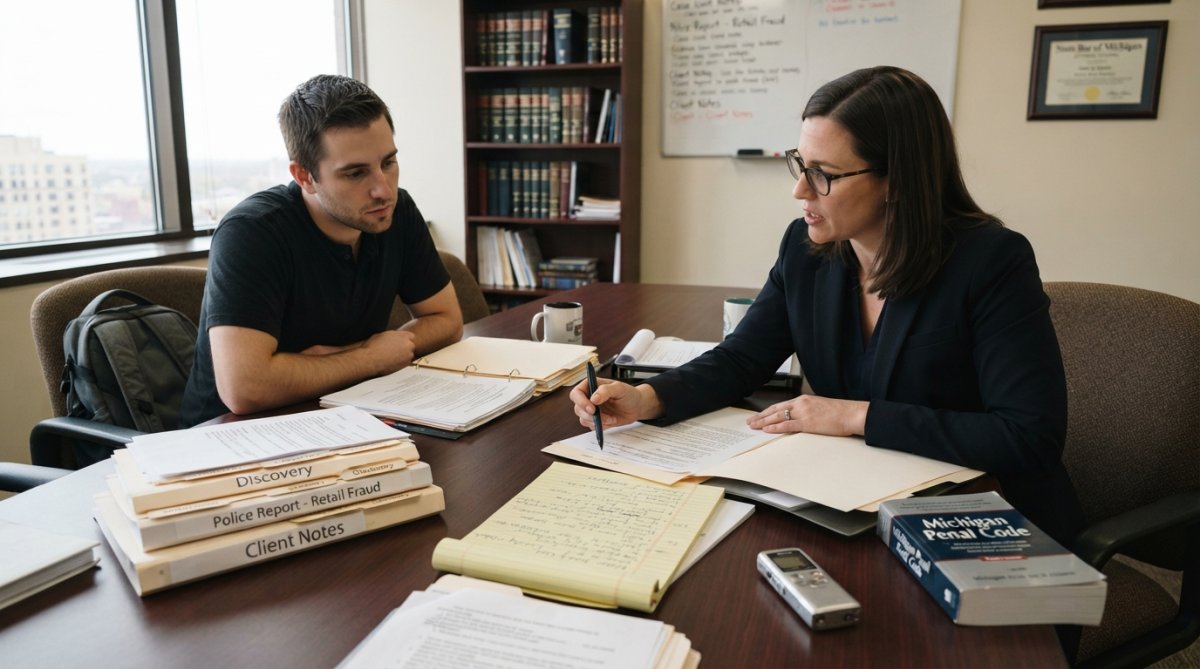
Arraignment and Probable Cause Hearing
Your arraignment is your first court appearance. You're informed of the charges, advised of your rights, and the court addresses bail or bond conditions. This is not the time to plead guilty or discuss the merits of your case.
The probable cause hearing typically follows within 14 days. Many cases are dismissed at this stage because the prosecution's evidence is weak, contradictory, or insufficient. Your attorney will cross-examine prosecution witnesses and highlight gaps in the evidence.
Pre-Trial Conference and Discovery Process
Before trial, your attorney and the prosecutor meet to discuss the case, exchange evidence, and explore settlement possibilities. During discovery, your attorney obtains all evidence the prosecution intends to use: police reports, witness statements, security footage, photographs, and any lab results. Your attorney also obtains "Brady material", evidence favorable to the defense that the prosecution is required to disclose.
Review all discovery materials carefully with your attorney. Look for inconsistencies, missing evidence, or information supporting your defense. If the prosecution fails to disclose exculpatory evidence, your attorney can file motions to suppress evidence or dismiss charges.
Motion Practice and Case Dismissal Opportunities
Motion practice is where experienced defense attorneys often win cases before trial. Common motions include:
- Motion to Suppress Evidence: Challenges whether evidence was obtained legally.
- Motion to Challenge Probable Cause: Argues that probable cause is insufficient to proceed.
- Motion to Suppress Statements: Challenges the admissibility of statements you made to police.
- Motion to Dismiss: Argues that charges should be dismissed due to legal defects or prosecutorial misconduct.
Successful motion practice can result in case dismissal without trial. Even unsuccessful motions create appellate issues and demonstrate to the prosecutor that your attorney is prepared to fight, which often encourages settlement negotiations.
Expungement for Retail Fraud Michigan: Clearing Your Record
Eligibility and Timeline for Record Sealing
Michigan's expungement law (MCL 780.621 et seq.) allows certain convictions to be sealed, removing them from public records. A sealed record means the conviction doesn't appear on background checks for most employers, landlords, or licensing boards.
Eligibility for expungement depends on the offense and sentence:
- Misdemeanor convictions: Eligible for expungement three years after sentence completion
- Felony convictions: Eligible for expungement five years after sentence completion
- Acquittals or dismissed charges: Eligible for immediate expungement
The timeline begins after you've completed your entire sentence, including probation. Expungement is not automatic, you must petition the court. Your attorney files a motion requesting that the conviction be sealed. The prosecutor has the right to object, though objections are rare for first-time offenders.
Long-Term Impact on Employment and Background Checks
A sealed record is invisible to most employers and landlords. When asked whether you've been convicted of a crime, you can truthfully answer "no", the sealed conviction doesn't count. This removes a major barrier to employment and housing.
However, certain employers and licensing boards retain the right to access sealed records. Law enforcement, healthcare licensing boards, and some professional licenses may still see your sealed conviction. Your attorney can advise you on which professions or licensing situations require disclosure.
Civil Demand Letters and Restitution: What You Need to Know
Understanding Retailer Demand Letters and Payment Obligations
After a retail fraud arrest, the store often sends a civil demand letter requesting payment for the merchandise value plus a statutory penalty. In Michigan, retailers can demand up to three times the merchandise value or $200, whichever is greater, but not to exceed $500 for a first offense.
Many people pay these demands believing they must, or hoping it will help their criminal case. This is a mistake. Paying a civil demand does not reduce criminal charges and can be used against you in court as an admission of guilt. Do not pay without consulting your attorney.
Negotiating Restitution and Probation Terms
If you're convicted or accept a plea deal, the court may order restitution, requiring you to repay the store for the merchandise value. Your attorney can negotiate restitution amounts, payment schedules, and probation terms that are realistic given your financial situation.
Probation conditions often include community service, counseling, or retail theft prevention programs. Your attorney can argue for reasonable conditions and push back against excessive or punitive requirements.
Why Hiring a Criminal Defense Attorney Is Critical to Your Case
Aggressive Representation and Trial Preparation
A retail fraud charge requires aggressive, strategic defense from day one. Your attorney must be willing to challenge the prosecution's evidence, file motions, cross-examine witnesses effectively, and prepare a compelling defense narrative. An attorney with specific experience defending retail fraud charges understands common weaknesses in the prosecution's case and knows how to exploit them.
Plea Bargain Negotiation and Diversion Program Options
Most retail fraud cases are resolved through plea negotiations or diversion programs, not trial. Your attorney's skill in negotiation directly affects the outcome you receive.
A skilled negotiator can convince the prosecutor to reduce charges, recommend probation instead of jail, or recommend diversion programs that allow you to avoid conviction entirely. Diversion programs typically involve completing community service, attending counseling, or paying restitution, and if you successfully complete the program, charges are dismissed. First-time offenders are often eligible for diversion programs.
At Coppins Law Group, PLLC, our team has extensive experience negotiating favorable outcomes in retail fraud cases. We understand what prosecutors are willing to accept and what judges are likely to recommend. This experience translates into better results for our clients, whether through charge reduction, diversion eligibility, or trial preparation that convinces the prosecutor to dismiss.
Summary: Your Path Forward
A retail fraud charge is serious, but not hopeless. Many cases are dismissed, reduced, or resolved through diversion programs that allow you to avoid conviction entirely. The key is aggressive, early intervention by an experienced criminal defense attorney who understands Michigan retail fraud law and is prepared to challenge the prosecution's evidence.
Coppins Law Group, PLLC provides dedicated criminal defense representation for retail fraud charges throughout Michigan. Our team offers steady guidance through the criminal justice process, aggressive courtroom representation, and strategic negotiation designed to protect your rights, reduce penalties, and preserve your future. We offer a free initial consultation to discuss your case and explore your legal options. Contact us today to begin your defense.
Frequently Asked Questions
What are the different degrees of retail fraud in Michigan?
Michigan retail fraud is classified under MCL 750.356c and MCL 750.356d. First-degree retail fraud involves property valued over $1,000 and is a felony. Second-degree involves property valued between $200-$1,000 and is a felony. Third-degree involves property under $200 and is a misdemeanor. Each degree carries different penalties, from fines and restitution to imprisonment. A criminal defense attorney can evaluate which degree applies to your case and develop appropriate defense strategies based on the property value and circumstances.
Can retail fraud charges be expunged in Michigan?
Yes, expungement for retail fraud Michigan is possible under certain conditions. If charges are dismissed or you are acquitted, you may petition for immediate expungement. If convicted, you must wait a statutory period, typically 5 years for misdemeanors or longer for felonies, before petitioning for record sealing. Expungement removes the conviction from public view, which significantly improves employment and background check outcomes. An experienced attorney can determine your eligibility and file the necessary petitions to clear your record.
What should I do immediately after being arrested for retail fraud?
First, exercise your right to remain silent and do not answer police questions without legal counsel present. Request a criminal defense attorney immediately, anything you say can be used against you. Document all details about the arrest, including officers' names, the store location, and what happened. Preserve any evidence in your favor, such as receipts or witness information. Contact a defense attorney for a free consultation to discuss your case, review the arrest report, and begin building your defense strategy before your arraignment.
What are common defenses to retail fraud Michigan charges?
Common defenses include challenging the probable cause for arrest, questioning the accuracy of security footage, proving mistaken identity, and demonstrating lack of intent to defraud. Loss prevention evidence may be unreliable or incomplete. You may have accidentally forgotten to pay, had a legitimate receipt, or been in the wrong place at the wrong time. A criminal defense attorney will analyze police reports, security footage, and witness statements to identify weaknesses in the prosecution's case and file motions to dismiss charges or suppress evidence.


