 how-to
How to Modify Child Custody Order: A Step-by-Step Guide
Table of Contents
- Understanding When You Can Modify Child Custody Order
- Material Change in Circumstances for Custody Modifications
- Step 1: Gather Evidence and Documentation
- Step 2: File Your Petition to Modify Custody
- Step 3: Serve the Other Parent with Legal Documents
- Child Custody Modification Mediation and Dispute Resolution
- Custody Modification Hearing Process: What to Expect
- Filing for Custody Modification Without a Lawyer
- Frequently Asked Questions
Last Updated: August 6, 2026
Understanding When You Can Modify Child Custody Order
A modify child custody order is a legal request to change the terms of an existing custody arrangement. Courts recognize that circumstances change after a custody order is entered and allow parents to petition for modifications when those changes are substantial and affect the child's best interests.
You can modify a child custody order in Michigan when material changes in circumstances have occurred since the original order was entered or last modified. This might include a parent's relocation, significant changes in work schedules, changes in the child's needs, or shifts in either parent's ability to provide care. Michigan law doesn't impose a strict waiting period, but courts require that any modification request demonstrate a genuine change in circumstances rather than a simple disagreement about the current arrangement.
The process involves filing a petition with the court, serving the other parent with legal documents, and potentially attending a hearing where a judge will decide whether to modify the existing custody order. Understanding each step helps you prepare properly and protect your interests and your child's welfare.
Material Change in Circumstances for Custody Modifications
A material change in circumstances for custody is the legal foundation for any custody modification. Michigan courts require clear evidence that something substantial has changed since the original custody order was entered or last modified. Without demonstrating a material change, your petition will likely be dismissed.
What qualifies as material varies depending on the facts. A parent's job loss, relocation to a different state, serious health issues, or changes in the child's educational or medical needs all constitute material changes. Similarly, if one parent has been unable to exercise their parenting time consistently, or if a child's living situation has become unsafe or unstable, those circumstances support a modification petition.
Courts also recognize changes in the child's preferences as the child grows older. A teenager's stated desire to live with one parent over another may constitute a material change, though courts weigh this alongside other factors including the child's age, the reason for the preference, and the stability of the proposed new arrangement.
A common misunderstanding is that a parent simply wanting more time with the child qualifies as a material change. It doesn't. The change must be external to the parent's preferences, something in the child's circumstances, the parents' circumstances, or the environment that genuinely affects the child's welfare.
Step 1: Gather Evidence and Documentation
Before filing any petition to modify custody, collect thorough documentation that supports your claim of material change. Evidence transforms your narrative into a compelling legal case.
Start by identifying what has changed. If you're claiming a parent has relocated, gather proof of the new residence, lease agreements, utility bills, school enrollment records, or employer documentation. If you're arguing that a child's needs have changed, collect medical records, school reports, psychological evaluations, or teacher communications. If you're claiming a parent has failed to exercise parenting time, maintain detailed records of attempted exchanges, missed pickups, or cancelled visits.
Documentation also includes communication records. Text messages, emails, and written exchanges between you and the other parent can establish patterns of behavior. Financial records matter too, if you're arguing that a parent's income has changed significantly, gather tax returns, pay stubs, or employment letters. Photographs of unsafe living conditions, inadequate sleeping arrangements, or hazardous environments speak clearly to a judge, but use them judiciously and legally.

Evidence Checklist for Custody Modification
Use this checklist to ensure you've gathered the key documentation needed to support your modification petition:
- Recent photographs of your living space showing adequate bedroom, bathroom, and common areas
- Current lease or mortgage documents proving your residence
- Recent utility bills or other proof of current address
- School enrollment records or transcripts showing your child's current school
- Medical records documenting any changes in the child's health, mental health, or special needs
- Psychological evaluations or therapist reports if relevant to the modification
- Employer letter confirming your employment status and work schedule
- Recent pay stubs or tax returns showing current income
- Calendar or log documenting parenting time exchanges and any missed visits
- Text messages, emails, or written communications relevant to the change in circumstances
- Documentation of any safety concerns (police reports, incident reports, photographs)
- Letters from teachers, coaches, or other professionals describing the child's current situation
- Evidence of your involvement in the child's activities, schooling, and healthcare
- Proof of any relocation (moving company records, new employment letter, lease agreement)
- Documentation of changes in the other parent's circumstances (if applicable)
Gathering this evidence takes time, but it's the foundation of a credible modification petition.
Step 2: File Your Petition to Modify Custody
Filing a petition to modify custody formally initiates the legal process. In Michigan, you'll file your petition with the circuit court in the county where the original custody order was entered, or where the child currently resides. Check your local court's website to ensure you have the correct documents.
The petition must include your case number, the names and birthdates of all parties and the child, a clear statement of what you're requesting, and a detailed explanation of the material change in circumstances supporting your request. This is where your evidence and documentation become critical, your written explanation must be specific, factual, and persuasive.
Michigan courts require that you file an affidavit along with your petition. An affidavit is a sworn statement under oath that describes the facts supporting your modification request. Your affidavit should be thorough, well-organized, and supported by the documentation you've gathered.
Filing fees apply in most Michigan courts, though fee waivers are available if you demonstrate financial hardship. Once you file your petition, the court will assign a case number and a judge, and you'll receive notice of any scheduled hearings or conferences.
Step 3: Serve the Other Parent with Legal Documents
Service of process is a legal requirement that ensures the other parent receives notice of your modification petition and has an opportunity to respond. In Michigan, you cannot simply hand documents to the other parent yourself. The documents must be served according to court rules, which typically means hiring a process server, having the sheriff serve the documents, or having an adult who's not a party to the case serve them.
The process server will deliver copies of your petition, affidavit, and any other filed documents to the other parent, along with a summons indicating the deadline for their response. The process server will then file an affidavit of service with the court, confirming that the other parent was properly served.
Get Your Free Consultation Now →
The other parent then has a specific timeframe (usually 21 days in Michigan) to file a response. They may agree to the modification, dispute it, or propose different terms. Proper service is essential, if the other parent claims they were never served, the court may dismiss your petition or delay proceedings.
Child Custody Modification Mediation and Dispute Resolution
Before many custody modification cases reach a judge, Michigan courts encourage or require mediation. Child custody modification mediation is a process where a neutral third party helps both parents negotiate a resolution without going to trial. Mediation can save time, reduce legal costs, and often results in agreements that both parents feel they've had a voice in creating.
In mediation, both parents and their attorneys (if represented) meet with the mediator to discuss the proposed modification. The mediator doesn't make decisions; they facilitate conversation, help identify common ground, and suggest creative solutions. Many parents find that mediation allows them to focus on their child's actual needs rather than getting locked into adversarial positions.
Not all custody modifications require mediation, but many judges will order it if both parents haven't already attempted it. If mediation results in an agreement, that agreement becomes the basis for a modified custody order that the judge will typically approve. If mediation doesn't resolve the dispute, both parents will proceed to a hearing.
Custody Modification Hearing Process: What to Expect
A custody modification hearing is a formal court proceeding where both parents present evidence and testimony before a judge. The parent who filed the modification petition (the petitioner) usually presents their case first. You'll be sworn in and testify about the material change in circumstances, your evidence, and why the modification serves your child's best interests. The other parent's attorney will have an opportunity to cross-examine you.
After the petitioner's case, the other parent (the respondent) presents their evidence and testimony. You'll have the opportunity to ask questions through cross-examination. Both sides may call witnesses, teachers, therapists, family members, or others with relevant knowledge about the child or the circumstances.
The judge will ask questions throughout the hearing to clarify facts or explore important details. After both sides present their cases, the judge may issue a decision from the bench or take the matter under advisement and issue a written decision later. If the judge modifies the custody order, the new order will specify the legal custody arrangement, physical custody arrangement, and parenting time schedule.
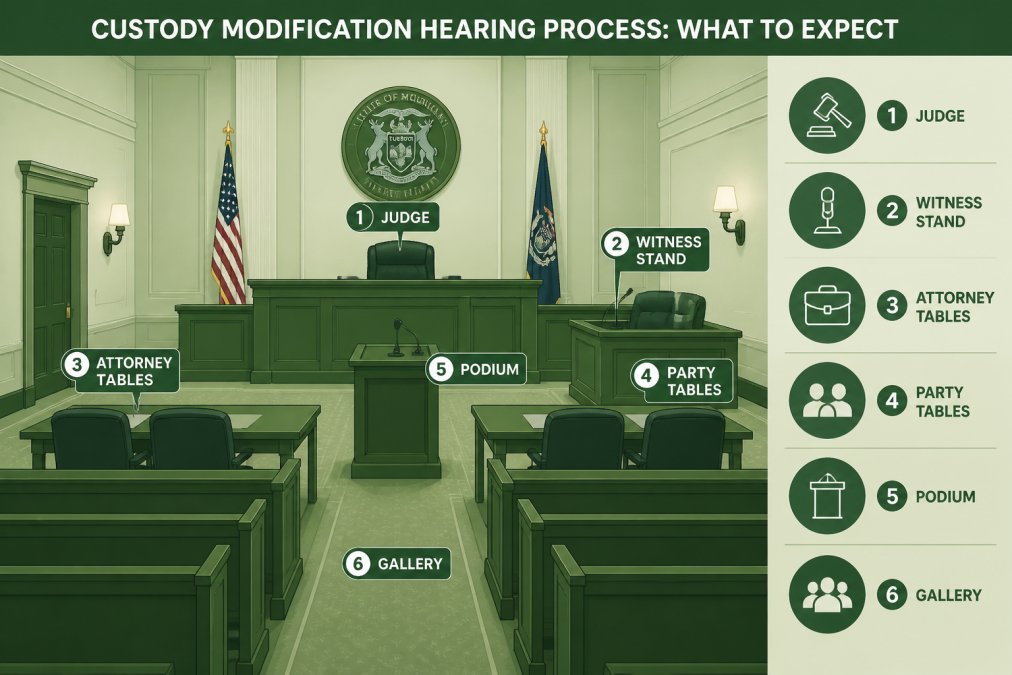
Hearings can be emotionally intense. Staying calm, speaking clearly, and sticking to factual testimony rather than emotional arguments helps you present yourself credibly to the judge.
Filing for Custody Modification Without a Lawyer
Filing for custody modification without a lawyer is legally possible in Michigan, though it requires careful attention to court procedures and deadlines. Many parents represent themselves (called "pro se" representation) in custody modification cases, particularly when both parents agree on the modification or when the change in circumstances is straightforward.
Representing yourself means you're responsible for understanding Michigan family law, completing the correct court forms, meeting all filing deadlines, and presenting your case effectively in court. One significant advantage is cost savings, you won't pay attorney fees. However, the time investment is considerable, and you'll need to research Michigan custody law, gather and organize evidence, prepare written documents, and practice your testimony.
Common challenges for self-represented parents include misunderstanding burden of proof, failing to present evidence in admissible form, and not knowing how to effectively cross-examine the other parent. If the other parent is represented by an attorney, you'll be at a disadvantage.
Coppins Law Group, PLLC offers free initial consultations where you can discuss your custody modification situation and understand your options. Even if you ultimately decide to represent yourself, an attorney can help you understand Michigan law, review your evidence, and advise you on strategy.
Modifying a child custody order is a significant legal undertaking, but it's a process designed to ensure that custody arrangements continue to serve your child's best interests as circumstances change. Whether you're facing a relocation, a change in your child's needs, or a shift in the other parent's ability to provide care, understanding the steps involved helps you approach the modification process with confidence. If you're considering a custody modification in Michigan, contact Coppins Law Group, PLLC for a free initial consultation to discuss your specific situation and explore how we can help protect your rights and your child's welfare throughout this process.
Frequently Asked Questions
What constitutes a material change in circumstances for custody modification?
A material change in circumstances is a significant change since the original custody order that affects the best interests of the child. Examples include a parent's relocation for work, a substantial change in income, a parent's health condition affecting their ability to care for the child, the child's own needs or preferences, or changes in the parent's living situation. The court evaluates whether the change is substantial enough to warrant modifying the existing custody order and whether modification serves the child's best interests.
Do I need a lawyer to modify a child custody order?
You can file for custody modification without a lawyer (called pro se representation), but it involves navigating court procedures, filing deadlines, and legal requirements. Many parents choose to work with an attorney to ensure proper documentation, stronger presentation of evidence, and better outcomes. If you cannot afford an attorney, some courts offer resources or fee waivers. Consulting with a lawyer for at least an initial review of your case can clarify your options and the strength of your modification request.
How long does the custody modification process typically take?
The timeline varies depending on whether the modification is contested or uncontested. Uncontested modifications where both parents agree may be resolved in weeks to a few months. Contested modifications requiring mediation, discovery, and a court hearing can take several months to over a year. Court schedules, the complexity of your case, and how quickly both parties respond to filings all affect the timeline. Your attorney or court clerk can provide a more specific estimate based on your local court's current caseload.
What forms do I need to file to modify a child custody order in Michigan?
Michigan requires you to file a Petition to Modify Custody Order (form MC 306) along with a summons and proof of service. You'll also need to file an affidavit detailing the material change in circumstances. If child support is involved, additional forms may be required. The exact forms and filing procedures depend on your county. Contact your local court clerk or visit your county court's website for the complete list of required forms and current filing fees or fee waiver options.


