 how-to
Protect Assets During Michigan Divorce: 7-Step Guide
Table of Contents
- Understanding Marital vs. Separate Property in Michigan Divorce
- Prenuptial and Postnuptial Agreements for Asset Protection
- Step-by-Step: How to Protect Assets During Michigan Divorce
- Step 1: Gather Complete Financial Documentation
- Step 2: Identify and Segregate Assets Early
- Step 3: Secure Retirement Accounts and Investment Accounts
- Step 4: Protect Digital Assets and Modern Property
- Step 5: Document Inheritance and Family Gifts
- Step 6: Hire Forensic Accounting and Legal Counsel
- Step 7: Monitor for Hidden Assets and Commingling
- Business Valuation and Protection in Michigan Divorce
- Penalties for Hiding Assets During Michigan Divorce
- Common Mistakes to Avoid When Protecting Assets in Michigan Divorce
- Asset Protection Checklist for Michigan Divorce
- Why Professional Legal Guidance Matters in Asset Protection
- Frequently Asked Questions
Last Updated: July 17, 2026
Protecting your assets during a Michigan divorce requires strategic planning, careful documentation, and professional guidance. This guide from Coppins Law Group, PLLC covers essential steps for how to protect assets during michigan divorce. Asset protection must begin before divorce papers are filed, not after.
Understanding Marital vs. Separate Property in Michigan Divorce
Michigan divides property into two categories: marital property (subject to division) and separate property (typically awarded to the owning spouse).
Marital property includes all property acquired during the marriage, regardless of whose name appears on the title. Separate property consists of assets owned before marriage, inheritances received in your individual name, gifts specifically given to you, and property explicitly excluded by prenuptial agreement. However, separate property loses its protected status if commingled with marital assets.
What Counts as Marital Property
If you acquired it during the marriage, it's presumed marital unless you prove otherwise. This includes real estate, 401(k) plans and IRAs, business interests, investment accounts, vehicles, digital assets and cryptocurrency, and bonuses and stock options tied to employment during marriage. A business started during marriage becomes marital property, even if one spouse created it with personal effort.
How to Establish and Document Separate Property
Proving separate property requires clear, contemporaneous documentation. Retain original deeds and purchase agreements showing pre-marriage acquisition dates. For inherited property, keep the will, trust document, or probate court order. Maintain separate bank accounts for pre-marital assets and keep statements showing the deposit source. If a family member gave you money as a gift, obtain written confirmation stating it's a gift to you, not the couple.
The strongest protection is a signed prenuptial or postnuptial agreement explicitly designating certain assets as separate property.
Prenuptial and Postnuptial Agreements for Asset Protection
Prenuptial and postnuptial agreements are the most powerful legal tools for protecting assets during michigan divorce. These contracts allow you to define property division in advance, bypassing Michigan's default equitable distribution rules.
When Prenuptial Agreements Protect Assets
A prenuptial agreement is a contract signed before marriage that specifies how property will be divided if the marriage ends. In Michigan, prenuptial agreements are enforceable if both parties have independent legal counsel, full financial disclosure occurs, and neither party signs under duress. Courts will enforce a prenuptial agreement even if it results in unequal asset division, provided the agreement was executed fairly with proper disclosure.
Using Postnuptial Agreements as a Second Line of Defense
A postnuptial agreement serves the same function as a prenuptial agreement but is signed during the marriage. If you didn't execute a prenuptial agreement, a postnuptial agreement is your second opportunity to define asset protection. Postnuptial agreements are enforceable in Michigan under the same standards as prenuptial agreements: independent legal counsel, full disclosure, and voluntary execution.
Step-by-Step: How to Protect Assets During Michigan Divorce
Step 1: Gather Complete Financial Documentation
Before any legal proceeding begins, compile a complete inventory of all financial accounts, property, and liabilities. Create a spreadsheet listing bank accounts, investment accounts, retirement accounts, real estate, vehicles, business interests, digital assets, valuable personal property, and liabilities with current balances and valuations. Obtain recent statements for all accounts, typically the most recent three to six months.
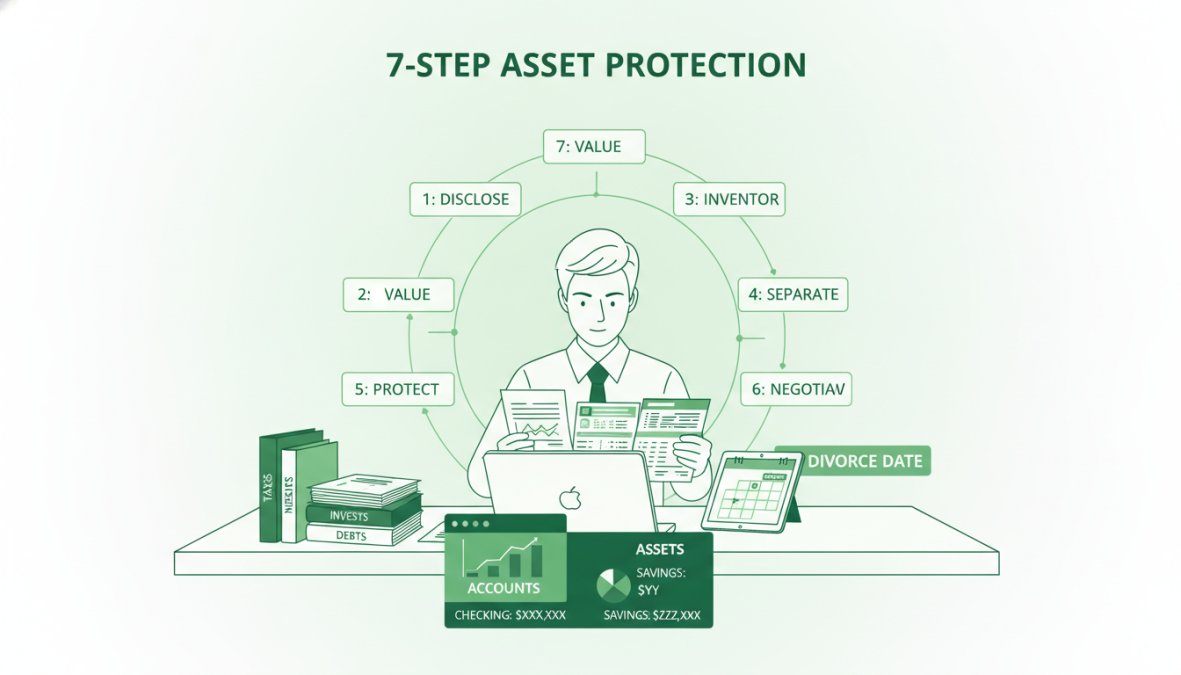
This step is non-negotiable. A complete, organized financial picture prevents disputes over asset values.
Step 2: Identify and Segregate Assets Early
Once you've inventoried your assets, identify which assets you claim are separate property and segregate them from marital assets. The legal principle is "tracing": Michigan courts will protect separate property only if you can trace it and show it remained segregated throughout the marriage.
Practical steps: Open a separate bank account in your name only for any inheritance or gift received during marriage. Maintain a separate business account if you own a pre-marital business. Keep investment accounts in your individual name, not joint accounts. Document the source of all deposits with bank statements and transfer records. Avoid depositing marital income into separate accounts.
This step should be taken before divorce is imminent. Segregating assets after learning divorce is likely may be viewed as an attempt to hide assets.
Step 3: Secure Retirement Accounts and Investment Accounts
Retirement accounts and investments are often the largest marital assets and require specific protection strategies.
401(k) and pension plans earned during marriage are marital property, but they're protected from immediate liquidation. Division occurs through a Qualified Domestic Relations Order (QDRO), a court order instructing the plan administrator to transfer a portion to an ex-spouse's separate IRA. Ensure your QDRO is drafted correctly by a specialist to avoid taxable distributions or loss of funds.
IRAs and Roth IRAs owned before marriage are separate property if they remain untouched and in your name only. However, contributions made during marriage using marital income become marital property. Document the source through account statements and contribution records.
Investment accounts acquired during marriage are marital property. However, if you funded them with pre-marital assets or inherited money, document the source through bank statements and transfer records.
Step 4: Protect Digital Assets and Modern Property
Digital assets, cryptocurrency, online businesses, domain names, and intellectual property are increasingly valuable but often overlooked in divorce proceedings.
Cryptocurrency owned before marriage is separate property, but proving the acquisition date and ownership is challenging. Maintain detailed records of all cryptocurrency holdings, including wallet addresses, purchase dates, and acquisition costs.
Online businesses created or developed during marriage are marital property. Their value is determined by revenue, profitability, and growth trajectory. Domain names, trademarks, and intellectual property created during marriage belong to the marital estate. Document the creation date, development history, and current value of all digital assets.
Step 5: Document Inheritance and Family Gifts
Inheritances and gifts are separate property in Michigan, but only if they remain in your name and aren't commingled with marital assets. An inheritance received during marriage is separate property if it's titled in your name only, you don't deposit inherited funds into joint accounts, you maintain clear documentation showing the inheritance source, and you keep inherited real estate in your individual name.
Gifts from family members to you (not the couple) are separate property if documented. A gift from your parents to you specifically is separate property. A gift given to both spouses is marital property.
Required documentation: Will or trust document showing you as beneficiary, probate court order or inheritance statement, bank statements showing the inheritance deposit into your individual account, gift letter from the gift giver stating the gift is to you, and correspondence confirming the gift's intent.
Step 6: Hire Forensic Accounting and Legal Counsel
Once you've gathered documentation, hire professionals specializing in asset protection during michigan divorce. Forensic accountants specialize in tracing assets, identifying hidden income, and valuing complex property. They're particularly valuable when your spouse owns a business, you suspect hidden assets, or significant assets are difficult to value.
Divorce attorneys specializing in asset protection know Michigan family law and can strategize to maximize your asset protection. The investment in these professionals typically pays for itself through better settlements.
Step 7: Monitor for Hidden Assets and Commingling
Asset protection continues throughout the divorce process. You must remain vigilant for hidden assets by your spouse and accidental commingling of your own assets.
Hidden assets are property your spouse conceals to avoid division. Common tactics include underreporting business income, transferring assets to family members, creating false debt, hiding cash income, delaying bonuses, and failing to disclose digital assets. Michigan courts have broad discovery powers to uncover hidden assets. If hidden assets are discovered, courts impose sanctions including attorney's fees and additional property awards.
Accidental commingling is your risk. As the divorce process unfolds, deposit bonuses, inheritances, or income into separate accounts immediately. Maintain clear records showing the source and separate status of all funds.
| Action | Timeline | Frequency | Impact |
|---|---|---|---|
| Gather financial documentation | Before filing | Once | Foundation for all protection |
| Segregate separate assets | Immediately | As assets arrive | Prevents commingling |
| Open separate accounts | Before divorce | Once | Protects inheritance/gifts |
| Hire professionals | Within 30 days of filing | Once | Uncovers hidden assets |
| Review spouse's disclosures | During discovery | Quarterly | Identifies inconsistencies |
| Update asset inventory | Throughout process | Monthly | Tracks new assets |
| Maintain documentation | Ongoing | Continuously | Proves separate property claims |
Business Valuation and Protection in Michigan Divorce
If you own a business, it's likely your largest asset and requires specialized protection strategies. A business created before marriage is separate property, but only if you can prove it predates marriage and remained your separate property throughout. A business created or substantially developed during marriage is marital property subject to division.
The critical protection is a buy-sell agreement executed before divorce. This agreement specifies what happens to business interests if divorce occurs, often triggering a mandatory buyout at a pre-agreed price. Without a buy-sell agreement, your spouse's interest becomes marital property.
Valuation Methods and Preventing Undervaluation
Business valuation is where most disputes arise in divorce. Michigan courts use three standard valuation methods: Income approach (values based on earnings capacity), Market approach (values based on comparable sales), and Asset approach (values based on net asset value).
Hire a qualified business valuation expert. Forensic accountants and business appraisers conduct thorough valuations using all three methods, supported by industry data and financial analysis. Proper business valuation requires analysis of financial statements, industry trends, competitive position, and management quality.
Penalties for Hiding Assets During Michigan Divorce
Michigan courts take hidden assets seriously. If you hide assets and the court discovers the concealment, sanctions include contempt of court (fines and jail time), attorney's fees and costs for the discovering spouse, adverse inference (assuming the worst about all your financial disclosures), punitive awards (additional property awarded as punishment), and loss of credibility on all testimony.
The discovery process is your mechanism to uncover hidden assets. You can require your spouse to produce bank statements, tax returns, account disclosures, answer interrogatories under oath, and submit to depositions. Red flags indicating hidden assets include missing bank statements or tax returns, unexplained transfers to family members, new accounts opened before separation, and business income that doesn't match tax returns.
Common Mistakes to Avoid When Protecting Assets in Michigan Divorce
Mistake 1: Commingling separate property with marital accounts. Depositing an inheritance into a joint savings account converts it to marital property instantly. Keep separate property in accounts titled in your name only.
Mistake 2: Failing to document separate property claims. Courts require contemporaneous documentation: deeds, purchase receipts, bank statements, gift letters, and inheritance documents.
Mistake 3: Transferring assets before disclosure. Moving assets to family members or hidden accounts creates fraud liability and triggers court sanctions.
Mistake 4: Undervaluing or overvaluing assets. Deliberately misrepresenting asset values destroys credibility and triggers sanctions. Use independent appraisals.
Mistake 5: Hiring inadequate legal counsel. Divorce law is specialized. Invest in attorneys who focus on family law and asset protection.
Mistake 6: Ignoring digital assets and modern property. Cryptocurrency, online businesses, and digital accounts are real assets with real value.
Mistake 7: Attempting to hide assets yourself. The penalties far exceed any benefit. Full disclosure is always the better strategy.
Mistake 8: Delaying asset protection until divorce is imminent. Asset protection is most effective when begun early, before divorce is threatened.
Mistake 9: Failing to monitor for commingling during divorce. Deposit new income, bonuses, or inheritances into separate accounts immediately.
Mistake 10: Neglecting to update beneficiary designations. Update life insurance, retirement accounts, and investment accounts to reflect your wishes post-divorce.
Asset Protection Checklist for Michigan Divorce
- Compiled complete inventory of all assets, investments, and liabilities with current values
- Gathered original documentation for all pre-marital assets
- Obtained inheritance documents, trust documents, and gift letters for separate property claims
- Opened separate bank accounts in your name only for pre-marital assets and inheritances
- Segregated pre-marital business interests into separate business accounts
- Documented the source of all funds in separate accounts
- Reviewed prenuptial or postnuptial agreement and confirmed enforceability
- Obtained current statements for all retirement accounts with beneficiary designations
- Documented all digital assets with wallet addresses and purchase records
- Listed all business interests with estimated valuations
- Identified all real estate with current market values and title documentation
- Compiled list of valuable personal property with estimated values
- Updated beneficiary designations on life insurance and retirement accounts
- Hired forensic accountant to analyze financial records
- Hired divorce attorney specializing in asset protection
- Reviewed spouse's financial disclosures for inconsistencies
- Requested complete discovery from spouse
- Maintained detailed records of all asset valuations
- Documented any new assets received during divorce in separate accounts
- Prepared for deposition regarding asset values and separate property claims
Why Professional Legal Guidance Matters in Asset Protection
Asset protection during michigan divorce is too complex and high-stakes for DIY approaches. An experienced divorce attorney understands Michigan property division law, knows how courts apply equitable distribution principles, and can strategize to maximize your asset protection. They coordinate with forensic specialists, negotiate settlements, and litigate when necessary.
Forensic accountants uncover hidden assets, trace commingled funds, and value complex property. Their analysis often reveals discrepancies that strengthen your settlement position. Business appraisers provide defensible valuations that courts respect. The cost of professional guidance is an investment in protecting your financial security.
Protecting your assets during divorce is one of the most important financial decisions you'll make. The strategies outlined in this guide, documenting separate property, executing prenuptial agreements, segregating assets, and hiring qualified professionals, form a comprehensive defense of your wealth. Coppins Law Group, PLLC provides dedicated legal advocacy for individuals navigating complex family law matters throughout Michigan, including comprehensive asset protection strategies, forensic analysis coordination, and strong courtroom representation. Get your free consultation now with Coppins Law Group, PLLC to discuss your asset protection strategy and explore your legal options.
Frequently Asked Questions
What is considered marital property vs. separate property in Michigan?
In Michigan, marital property includes assets acquired during the marriage and is subject to equitable distribution. Separate property, such as assets owned before marriage, inheritances, or gifts designated for one spouse, may be protected from division. However, commingling separate property with marital assets can cause it to lose its protected status. Proper documentation and tracing of separate property is critical to protect assets during Michigan divorce proceedings.
Can a prenuptial agreement Michigan asset protection strategy really protect my assets?
Yes, a valid prenuptial agreement can significantly protect assets during divorce if properly drafted and executed. Michigan courts enforce prenuptial agreements that are fair, made with full financial disclosure, and signed voluntarily by both parties. A postnuptial agreement can offer similar protection after marriage. Both documents allow you to specify which assets remain separate property and how marital property will be divided, reducing uncertainty and litigation costs during divorce proceedings.
What are the penalties for hiding assets during a Michigan divorce?
Hiding assets during divorce carries serious consequences, including contempt of court charges, monetary sanctions, attorney's fees imposed on the hiding spouse, and adverse judgments where the court awards more assets to the other spouse as punishment. Judges may also award the other spouse all disputed assets or additional alimony. Discovery processes and forensic accounting can uncover hidden assets, making concealment a risky and ultimately unsuccessful strategy that damages credibility with the court.
How should I protect my retirement accounts and business during Michigan divorce?
Protect retirement accounts by documenting their separate property status if applicable, obtaining a Qualified Domestic Relations Order (QDRO) to formalize any division, and working with your attorney to negotiate favorable settlement terms. For business protection, hire a forensic accountant for accurate business valuation, establish clear documentation of business ownership and structure, and consider negotiating a buyout or structured division rather than forced sale. Professional business valuation prevents undervaluation and protects your interests in asset division.


