 blog
blog
Why You Need a Lawyer for Divorce: Protect Your Rights
Table of Contents
- Why You Need a Lawyer for Divorce: The Core Reasons
- When to Hire a Divorce Lawyer: Critical Situations
- What Does a Divorce Lawyer Do: Essential Functions
- Benefits of Hiring a Divorce Attorney: Why It Matters
- Cost of Divorce Lawyer vs. No Lawyer: Understanding the Trade-Off
- The Risks of Going Without Legal Counsel
- How to Choose a Divorce Lawyer in Michigan
- Frequently Asked Questions
Last Updated: July 16, 2026
Why You Need a Lawyer for Divorce: The Core Reasons
Divorce reshapes your legal status, financial position, and family structure. Without proper legal counsel, you risk losing assets, facing unfavorable custody arrangements, and making decisions that affect your financial security for decades. Property division, child custody, spousal support, and debt liability require deliberate legal action. A divorce lawyer protects your interests at every stage, from initial negotiations through trial if necessary.
Legal Rights Protection
Your legal rights in a divorce extend far beyond splitting bank accounts. Michigan law recognizes specific rights around marital assets, child custody, parenting time, and spousal support. Without a lawyer, you may unknowingly waive rights you didn't know you had. Divorce law is highly fact-dependent, what applies to your neighbor's situation may not apply to yours. A lawyer evaluates your specific circumstances, income, the length of your marriage, and your children's needs, and advises you on what's realistic and fair under Michigan law.
Complex Asset Division and Debt Liability
Marital assets and debts are rarely straightforward. Homes, retirement accounts, investment portfolios, businesses, and vehicles all require proper valuation and division. Michigan follows equitable distribution principles, meaning assets are divided fairly, not necessarily 50/50.
Retirement accounts like 401(k)s and pensions require specific legal language (a Qualified Domestic Relations Order, or QDRO) to divide without triggering tax penalties. Missing this detail can cost thousands in unexpected taxes. A lawyer identifies hidden assets, challenges inflated valuations, and ensures debts are assigned appropriately. Without this scrutiny, you might assume debt you shouldn't bear or miss valuing an asset your spouse is concealing.
Child Custody and Parenting Plan Advocacy
Child custody decisions carry emotional and legal weight demanding expert handling. Michigan law prioritizes the "best interests of the child," but that phrase means different things depending on the judge and facts. A parenting plan is a legal document governing decision-making authority, visitation rights, and how major life decisions are made.
Courts consider each parent's relationship with the child, the child's preferences, stability, and each parent's ability to meet the child's needs. A lawyer builds a compelling narrative around these factors and presents evidence that supports your custody position. Without legal representation, you're arguing your case to a judge without training in how courts evaluate parental fitness.
When to Hire a Divorce Lawyer: Critical Situations
If your marriage involves children, significant assets, debt, or any hint of conflict, you need a lawyer. Even in seemingly amicable divorces, having a lawyer review agreements protects you from mistakes that create major problems later.
Contested vs. Uncontested Divorce
An uncontested divorce occurs when both spouses agree on all major issues: asset division, child custody, support obligations, and divorce terms. However, "uncontested" doesn't mean you don't need a lawyer, it means you need a lawyer to ensure the agreement is actually in your best interest.
Many people settle quickly to end conflict, only to discover months later that they agreed to unfavorable terms. A lawyer reviews your settlement agreement and asks critical questions: Are you receiving your fair share of marital assets? Is the custody arrangement realistic given your work schedule? Does the spousal support amount make sense given both parties' incomes?
A contested divorce means you and your spouse disagree on custody, asset division, support, or other material issues. In contested divorces, a lawyer becomes essential. The court will decide contested issues, and your lawyer presents evidence and arguments to convince the judge to rule in your favor.
Domestic Violence and Protective Orders
Domestic violence fundamentally changes the divorce landscape. If you or your children have experienced abuse, your immediate priorities shift to safety and protective orders. A lawyer helps you obtain a domestic violence protective order and ensures it includes provisions that protect your custody rights.
Domestic violence also influences custody decisions. Courts take abuse seriously when determining parenting time and custody. A lawyer documents the abuse and argues for custody arrangements that keep you and your children safe. Additionally, if your spouse files for divorce and claims you're the abuser, you need immediate legal defense to counter false allegations with facts.
What Does a Divorce Lawyer Do: Essential Functions
A divorce lawyer's role extends far beyond appearing in court. They manage the entire legal process, from initial consultation through final decree.
Court Filings and Legal Procedures
Divorce involves specific legal filings, deadlines, and procedural rules. Missing a deadline or filing a document incorrectly can result in sanctions, default judgments, or delays that cost thousands in additional legal fees. A lawyer ensures all documents are filed on time, in the correct format, with proper signatures and notarizations.
Michigan courts have specific rules about discovery (exchanging financial information), depositions, and trial procedures. A lawyer navigates these rules strategically to gather information supporting your case. A lawyer also handles service of process, ensuring your spouse is properly notified of the divorce and all legal documents. If service is improper, the entire divorce may be invalid.
Negotiation and Settlement Agreement Drafting
Most divorces settle before trial, making negotiation critical. A lawyer negotiates on your behalf, advocating for your interests while remaining professional and solution-focused. A lawyer drafts settlement agreements that translate verbal agreements into enforceable legal language, addressing every issue: property division, debt allocation, custody, visitation, child support, spousal support, and tax considerations. Vague or incomplete language creates disputes later.
Litigation Representation and Trial Preparation
If settlement negotiations fail, your case proceeds to trial. Trial preparation is intensive. Your lawyer gathers evidence, prepares witnesses, and develops a compelling narrative for the judge. At trial, your lawyer examines witnesses, presents evidence, and makes legal arguments. They cross-examine your spouse and their witnesses, highlighting inconsistencies and weaknesses in their testimony.
Benefits of Hiring a Divorce Attorney: Why It Matters
Emotional and Psychological ROI
Divorce is emotionally draining. In this emotional state, making clear-headed legal decisions is nearly impossible. A lawyer provides emotional distance and objectivity. When you're tempted to agree to unfavorable terms just to end conflict, a lawyer reminds you of your long-term interests. Studies consistently show that people who work with lawyers report higher satisfaction with their divorce outcomes.
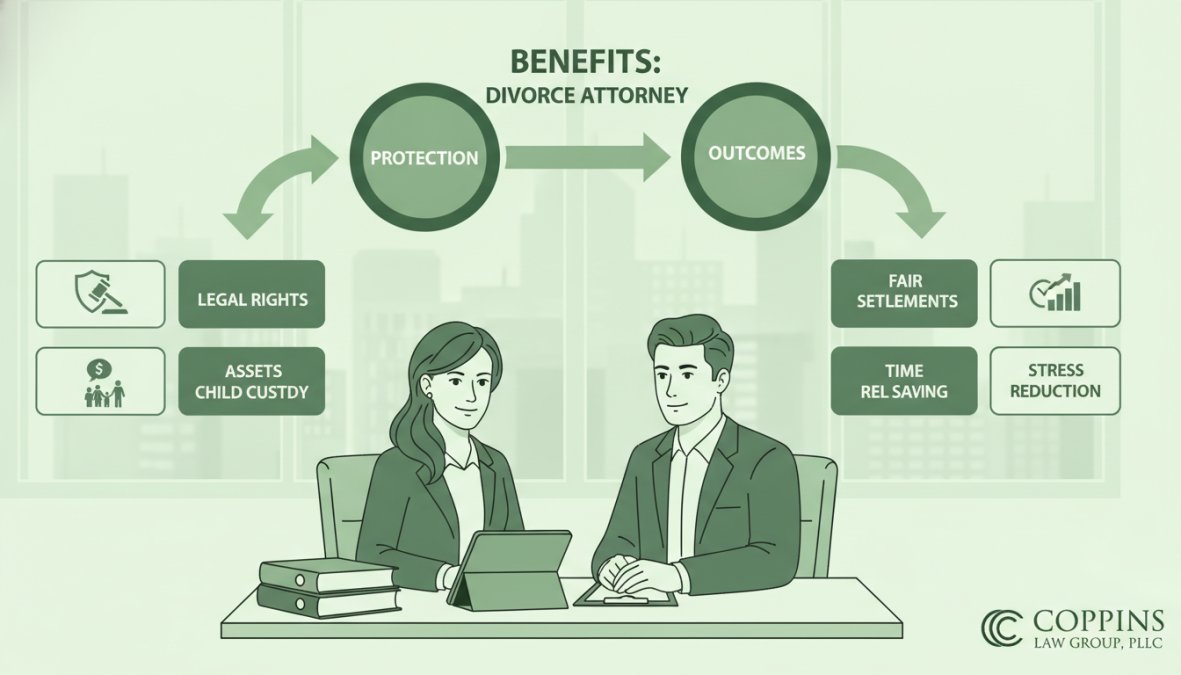
Having a lawyer reduces stress and anxiety. You know someone with expertise is handling your case. You can focus on your children, your job, and your emotional recovery while your lawyer handles the legal work.
Strategic Advantage in Negotiations
A lawyer brings strategic thinking to your divorce. They identify your strongest arguments, anticipate your spouse's positions, and develop negotiation strategies that maximize your use. They know what judges typically award in similar cases, which helps set realistic expectations.
A lawyer also prevents costly mistakes. For example, many people voluntarily reduce their income during divorce without understanding how it affects child support and spousal support calculations. A lawyer advises you on how financial decisions impact your legal position and prevents you from making statements to your spouse that could be used against you later.
Cost of Divorce Lawyer vs. No Lawyer: Understanding the Trade-Off
The cost of hiring a divorce lawyer is a legitimate concern. However, comparing the cost of a lawyer to the cost of no lawyer requires looking at the full financial picture, including what you might lose.
DIY Divorce Red Flags and Hidden Risks
A DIY divorce seems appealing because it saves legal fees. However, DIY divorces create hidden costs and risks that often exceed what you would have paid a lawyer.
Common DIY mistakes include undervaluing assets, failing to properly divide retirement accounts, agreeing to unfavorable custody arrangements, and accepting excessive debt liability. These mistakes often don't surface until months or years after the divorce is final. For example, a DIY divorce might fail to address what happens if your ex-spouse dies or doesn't clearly specify who pays for the children's college education. These omissions create disputes and additional legal costs later.
Low-Cost Legal Alternatives and Limited Scope Representation
If cost is a genuine barrier, several lower-cost alternatives exist. Limited scope representation allows you to hire a lawyer for specific tasks, perhaps just reviewing a settlement agreement or handling contested custody issues, while you handle other aspects yourself. This hybrid approach reduces costs while still giving you expert guidance on critical issues.
Mediation is another option. A mediator helps you and your spouse negotiate a settlement. Mediation costs less than litigation because there's no trial preparation. However, mediation requires both parties to act in good faith and be willing to compromise.
The Risks of Going Without Legal Counsel
The risks of proceeding without a lawyer are substantial and often irreversible. Once a divorce is final, changing the terms is difficult and expensive.
Unequal Bargaining Power and Long-Term Consequences
In any negotiation, one party typically has more information or advantage than the other. In divorce, if your spouse has handled finances and you haven't, they may have significant information advantages. A lawyer levels this playing field by demanding full financial disclosure and identifying inconsistencies.
The financial consequences of a bad divorce settlement compound over time. If you accept an unfavorable property division, you're living with that decision for the rest of your life. If you agree to excessive spousal support, you're paying it for years. Similarly, custody arrangements that seemed acceptable at divorce often become problematic as circumstances change. A lawyer drafts agreements that anticipate these changes and include language addressing them, preventing future litigation.
How to Choose a Divorce Lawyer in Michigan
Choosing the right lawyer is critical. You're entrusting someone with your family's future and your financial security.
Evaluating Experience and Courtroom Readiness
Not all lawyers are equally experienced in divorce. When evaluating a lawyer, ask about their specific experience with divorce cases. How many divorces have they handled? How many went to trial? What's their success rate in contested cases?
Experience matters because divorce law is nuanced. A lawyer experienced in high-asset divorces understands valuation issues that a lawyer who primarily handles simple, uncontested divorces might miss. Ideally, your lawyer is skilled at both negotiation and litigation, prepared and willing to take your case to trial if necessary.
Free Initial Consultation: What to Expect
Most divorce lawyers offer free initial consultations. Come prepared with basic information about your marriage, children, assets, and the main issues in dispute.
During the consultation, a good lawyer listens more than they talk. They ask questions to understand your situation, goals, and concerns. They explain the legal process in understandable language and give you realistic expectations about outcomes and costs. Also evaluate the lawyer's communication style. Will they be accessible if you have questions? Do they explain things clearly, or do they use jargon without explanation? You'll be working closely with this person during a stressful time, so compatibility matters.
Coppins Law Group, PLLC offers free initial consultations where our experienced family law attorneys listen to your situation and explain your legal options. We've guided Michigan families through contested and uncontested divorces, and we understand the emotional and financial stakes. During your consultation, we'll be direct about what your case involves, what you can realistically expect, and how we can help protect your rights.
Divorce forces you to make decisions that affect your family's future for decades. The complexity of asset division, child custody, spousal support, and legal procedures demands expertise you likely don't possess. Attempting to navigate divorce without a lawyer exposes you to financial loss, inadequate custody protections, and legal mistakes that are expensive or impossible to correct later. Coppins Law Group, PLLC provides steady guidance and strong courtroom representation to protect your rights and future. Get your free consultation now to discuss your case and explore your legal options.
| Situation | Best Approach | Key Benefit |
|---|---|---|
| Uncontested divorce, no children, minimal assets | Limited scope representation or DIY with lawyer review | Lower cost while protecting key interests |
| Uncontested divorce with children | Full representation | Ensures custody and support terms are fair and enforceable |
| Contested divorce, significant assets | Full representation with trial preparation | Protects financial interests and maximizes use in negotiations |
| Domestic violence involved | Immediate legal representation | Ensures safety protections and custody advantages |
| Spouse owns business or has complex assets | Full representation with expert valuation | Identifies hidden assets and ensures fair division |
Frequently Asked Questions
Can you get a divorce without a lawyer?
Technically, yes, you can file pro se (represent yourself) in an uncontested divorce with no children or minimal assets. However, this approach carries significant risks: missed filing deadlines, improper legal language, overlooked asset claims, and unenforceable agreements. Even seemingly simple divorces often involve hidden complexities. A lawyer for divorce ensures proper procedures, protects your legal rights, and prevents costly mistakes that could affect you for years.
When should you hire a divorce lawyer?
You should hire a divorce lawyer immediately if your divorce is contested, involves children, significant marital assets, domestic violence, or if your spouse already has legal representation. Even in uncontested situations, early consultation prevents problems. A lawyer can advise whether mediation, limited scope representation, or full litigation suits your case. The sooner you engage legal counsel, the better they can protect your interests from the outset of court procedures.
What does a divorce lawyer do to protect my rights?
A divorce attorney handles court filings, negotiates settlement agreements, manages asset division and debt liability issues, and advocates for your interests in custody disputes and parenting plans. They ensure equitable distribution of marital assets, protect against hidden liabilities, and represent you in litigation if needed. They also draft the divorce decree and ensure all legal procedures are followed correctly, safeguarding your legal rights throughout the process.
What are the main risks of DIY divorce without legal counsel?
DIY divorce red flags include missing filing deadlines, incorrect legal language that invalidates agreements, overlooking marital assets or hidden debts, unfavorable custody arrangements, and agreements that are unenforceable in court. Without a lawyer, you may also face challenges if your spouse has legal representation, creating an unequal bargaining position. These mistakes often cost far more to fix later than hiring a lawyer upfront would have cost initially.