 listicle
7 Steps to File for Divorce in Michigan
Table of Contents
- Step 1: Confirm You Meet Michigan Residency Requirements
- Step 2: Understand Divorce Filing Fees and Court Costs
- Step 3: Prepare and File Your Complaint for Divorce
- Step 4: Serve Your Spouse with Divorce Papers
- Step 5: Handle Discovery and Temporary Orders
- Step 6: Resolve How Long a Divorce Takes in Michigan
- Step 7: Finalize the Judgment of Divorce
- DIY Divorce vs. Attorney Representation: Cost and Complexity
- Frequently Asked Questions
Last Updated: August 14, 2026
Step 1: Confirm You Meet Michigan Residency Requirements
Before filing for divorce in Michigan, you must establish residency in the state. Michigan law requires that at least one spouse has lived in the state for a minimum of 180 days immediately before filing the complaint for divorce. Count backward from your intended filing date, the 180-day clock starts when you establish residency, typically when you move into a residence with intent to stay. You don't need to own property or establish a driver's license, though these help document your presence.
You must file in the circuit court of the county where either you or your spouse currently resides. Simply living in Michigan with intent to remain qualifies, even if you're staying with family or in temporary housing.
Step 2: Understand Divorce Filing Fees and Court Costs
Filing for divorce in Michigan requires paying court filing fees. Most circuit courts charge between $200 and $300 for the initial complaint filing, with some counties charging additional fees for serving papers or processing specific documents. Contact your county's circuit court clerk's office directly for exact fees in your jurisdiction.
Beyond the filing fee, you'll encounter costs for process servers ($75-$150), court transcripts, document copying, and certified copies. For uncontested divorces where both spouses agree on all terms, total cost can be kept relatively low. For contested divorces, costs escalate significantly as you move through discovery, temporary orders, and potentially trial preparation.
Step 3: Prepare and File Your Complaint for Divorce
The complaint for divorce is the formal legal document that starts your case. It tells the court you want a divorce, provides basic information about you and your spouse, and outlines your initial requests regarding property division, custody, and support if applicable.
Michigan has specific forms available from your county's circuit court website or the Michigan courts website. The form asks for identifying information about both spouses, the date of marriage, information about minor children if any, and a statement of grounds for divorce. Michigan is a no-fault divorce state, meaning you simply state that "there has been a breakdown of the marriage relationship to the extent that the objects of matrimony have been destroyed and there remains no reasonable likelihood that the marriage can be preserved."
Complete the form carefully. Errors or omissions can delay processing or require amended documents. Make copies of the completed form, you'll need the original plus copies for the court, your spouse, and your records. File the original with the circuit court clerk in your county. The clerk will assign a case number and return a stamped copy showing it's been received.

If you're using a service like DivorceWriter or the Michigan Legal Help DIY tool, these services generate completed forms tailored to Michigan requirements and produce ready-to-file documents.
Step 4: Serve Your Spouse with Divorce Papers
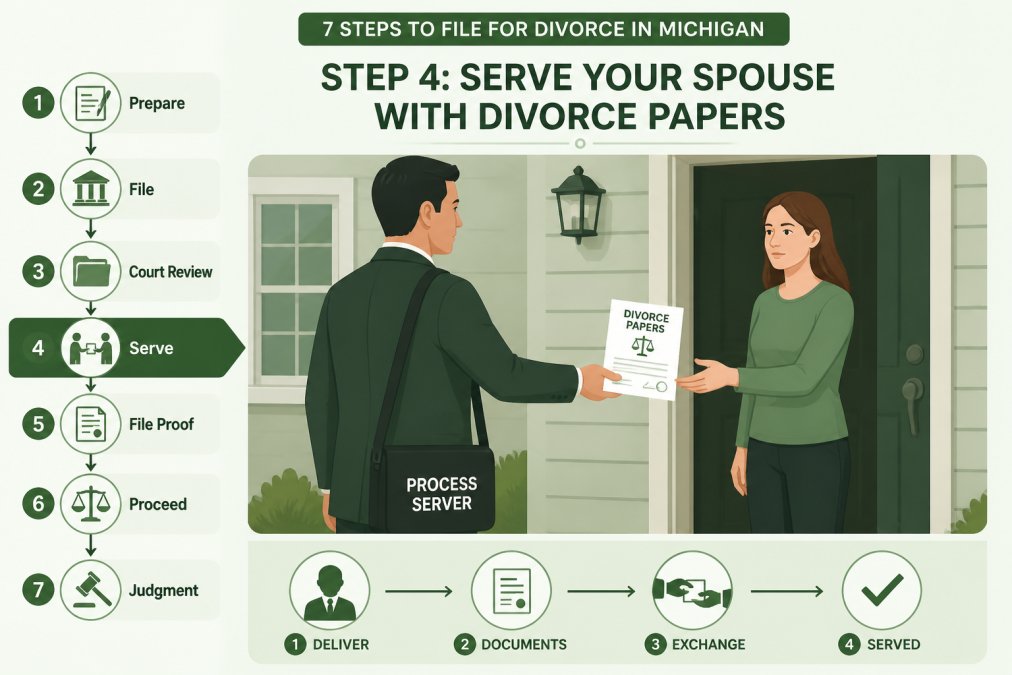
Service of process means legally notifying your spouse that you've filed for divorce. Michigan law requires proper service, your spouse must receive the complaint and summons through an official method.
The most common method is hiring a process server, a professional who delivers the documents in person and files an affidavit with the court proving service occurred. This costs $75 to $150 depending on location. An alternative is having the sheriff's department serve the papers, often for a lower fee. If your spouse agrees to accept service voluntarily, they can sign an acknowledgment of receipt, avoiding the need for a process server.
Never serve your spouse yourself. Michigan law prohibits the person filing from serving papers, it must be done by a neutral third party. After service occurs, the process server files a proof of service with the court. Without proof of service, the court won't proceed.
If your spouse cannot be located, you can request service by publication, where the court allows you to publish notice in a newspaper instead.
Step 5: Handle Discovery and Temporary Orders
Discovery is the process where both spouses exchange financial and personal information, including tax returns, bank statements, investment account records, mortgage documents, and information about debts. Discovery methods include interrogatories (written questions), requests for production of documents, and depositions (recorded interviews under oath). For uncontested divorces, discovery is often simplified or skipped entirely if both parties voluntarily share information.
Temporary orders are court orders issued during the divorce process, before the final judgment. These might address who stays in the marital home, temporary child custody arrangements, temporary support payments, or who pays certain bills while the divorce is pending. If you and your spouse disagree on temporary matters, either party can request a temporary orders hearing.
Many divorces settle during or shortly after discovery. Once both spouses understand the full financial picture, they often realize litigation is expensive and negotiate a settlement agreement.
Step 6: Resolve How Long a Divorce Takes in Michigan
How long a divorce takes depends entirely on whether it's contested or uncontested. An uncontested divorce can be finalized in as little as 30 to 60 days after the 21-day waiting period expires. Michigan law requires a 21-day waiting period between filing and final judgment.
A contested divorce takes significantly longer. If spouses disagree on custody, property division, support, or other major issues, the case moves through discovery, temporary orders hearings, settlement conferences, and potentially trial. Contested divorces commonly take 6 months to 18 months, sometimes longer if the case is complex or court calendars are crowded.
Settlement conferences, where a judge or mediator meets with both spouses to encourage settlement, often happen 3 to 6 months into the case. Many divorces settle at or shortly after these conferences. If settlement doesn't happen, the case proceeds toward trial, which can add several more months.
| Timeline Factor | Uncontested | Contested |
|---|---|---|
| Waiting period | 21 days (required) | 21 days (required) |
| Document preparation | 1-2 weeks | 2-4 weeks |
| Service and response | 2-4 weeks | 4-8 weeks |
| Discovery phase | Minimal or skipped | 2-4 months |
| Settlement negotiations | Days to weeks | 3-6 months |
| Trial preparation | N/A | 2-4 months |
| Total timeline | 30-60 days | 6-18 months |
Step 7: Finalize the Judgment of Divorce
The judgment of divorce is the final court order that ends your marriage. It addresses all issues, property division, custody, support, and any other matters. Once signed by the judge, it becomes binding and enforceable.
Get Your Free Consultation Now →
For uncontested divorces, you and your spouse draft a settlement agreement covering all issues, submit it to the judge, and if approved, a judgment of divorce is entered. For contested divorces, the judgment comes after trial. The judge hears evidence from both sides, makes decisions on disputed issues, and issues a written judgment.
The judgment must address several required elements in Michigan: it must identify both spouses, state the grounds for divorce, address property and debt division, and if minor children are involved, address custody, parenting time, and child support. After the judgment is signed, you're legally divorced and the judgment becomes a public record.
DIY Divorce vs. Attorney Representation: Cost and Complexity
The choice between handling your divorce yourself (pro se) and hiring an attorney depends on complexity, cost, and your comfort with legal processes.
DIY Divorce Approach
A do-it-yourself divorce using online tools or court forms is the cheapest option. Services like the Michigan Legal Help DIY tool (free), DivorceWriter ($137), and OnlineDivorce.com (starting around $159) generate completed forms you file yourself. You pay only the filing fee and service costs, typically totaling $300 to $400 for an uncontested divorce.
The DIY approach works best when your divorce is uncontested, you and your spouse agree on everything, have no minor children, and have minimal assets to divide. Common mistakes in DIY divorces include incomplete financial disclosures, incorrect child support calculations, missing required documents, and failure to address tax implications of property division.
Attorney Representation
Hiring an attorney provides guidance through every step, legal advice tailored to your situation, and courtroom representation if needed. An attorney protects your rights, ensures all documents are correct, and handles communication with the other party's attorney or the court.
Coppins Law Group, PLLC offers free initial consultations to discuss your divorce situation and explore your options. Our experienced team provides steady guidance through the divorce process, whether your case is straightforward or involves complex custody, support, or property issues. We deliver strategic representation focused on protecting your rights and achieving the best outcome for your specific circumstances.
For uncontested divorces handled by an attorney, costs depend on complexity and how long the case takes. For contested divorces, costs depend on complexity and how long the case takes.
Comparison Framework
| Situation | Best Option | Why |
|---|---|---|
| Uncontested, no children, minimal assets | DIY tools or document prep service | Cost savings justified; low complexity |
| Uncontested, minor children involved | Attorney consultation + DIY | Ensure child support calculations are correct |
| Contested or complex property | Attorney representation | Protects your financial interests |
| High-conflict or domestic violence history | Attorney representation | Need professional negotiation and protection |
| First-time divorce, uncertain about process | Attorney consultation | Clarify your options before committing |
A seemingly simple DIY divorce can become expensive if errors surface later. Incorrect child support calculations mean revisiting court. Incomplete property division creates disputes years later. Attorney fees to fix these problems often exceed what full representation would have cost initially. Many attorneys offer limited-scope representation, handling just specific parts of your divorce, which costs less than full representation while still protecting key interests.
Filing for divorce in Michigan involves specific steps, court requirements, and deadlines. Whether you handle it yourself or work with an attorney, understanding the process helps you move forward confidently. If you're facing a contested divorce, have minor children, or own significant property, professional guidance protects your interests and prevents costly mistakes. Coppins Law Group, PLLC provides free initial consultations to discuss your divorce situation and help you understand your legal options. Contact us today to explore how we can guide you through this transition with steady, focused representation.
Frequently Asked Questions
What are the residency requirements to file for divorce in Michigan?
To file for divorce in Michigan, at least one spouse must be a resident of the state for a minimum period before filing. The specific residency duration and requirements are established by Michigan law and enforced through the circuit court system. You should verify the exact residency timeline with the circuit court in your county or consult with an attorney to confirm you meet all eligibility requirements before filing your complaint for divorce.
How much does it cost to file for divorce in Michigan?
Divorce filing fees in Michigan vary by county and depend on whether your divorce is contested or uncontested. Court filing fees represent only one cost component; you may also incur expenses for service of process, document preparation, and potential attorney fees if you choose representation. For exact divorce filing fees specific to your county's circuit court, contact the court clerk directly or visit your county's court website. If cost is a concern, ask about fee waivers or reduced-fee options during your free initial consultation.
How long does a divorce take in Michigan?
The timeline for divorce in Michigan depends on whether your case is contested or uncontested. An uncontested divorce where both parties agree on all terms typically resolves faster than a contested divorce involving disputes over custody, support, or property division. Factors affecting duration include court schedules, discovery complexity, and whether mediation or settlement conferences occur. Most divorces take several months to over a year. Consulting with an attorney can help you understand realistic timelines for your specific situation.
Can I file for divorce without an attorney in Michigan?
Yes, you can file for divorce without an attorney (called filing pro se) in Michigan, particularly for uncontested divorces where both spouses agree on all terms. However, the process requires accurate completion of court forms, proper service of process, and understanding of Michigan family law. Free resources like Michigan Legal Help's DIY Divorce Tool or online document preparation services can assist. For contested divorces or cases involving minor children, having legal representation significantly protects your rights and ensures compliance with discovery, temporary orders, and equitable distribution requirements.
What is the difference between serving divorce papers and filing them?
Filing means submitting your complaint for divorce to the circuit court clerk, creating an official court record. Serving means delivering a copy of those divorce papers to your spouse through proper legal process, which proves they received notice of the lawsuit. Both steps are required: you file with the court, and your spouse must be served according to Michigan service of process rules. Improper service can invalidate the entire divorce, so following the correct procedures is critical to moving forward with your case.