 listicle
6 Ways to Handle Divorce Without Spouse Signature
Table of Contents
- 1. Pursue a Default Divorce Through the Courts
- 2. Properly Serve Your Spouse With Divorce Papers
- 3. Use Mediation to Reach an Agreement
- 4. File for a Contested Divorce and Let the Court Decide
- 5. Explore Legal Separation as an Alternative
- 6. Hire an Attorney to Navigate the Process
- Managing the Emotional and Financial Toll
- Frequently Asked Questions
Last Updated: August 19, 2026
1. Pursue a Default Divorce Through the Courts
A default divorce allows you to proceed with divorce proceedings when your spouse refuses to participate or sign documents. You file the initial petition for dissolution of marriage with the court, and your spouse becomes the respondent who must be formally served. If they fail to file a response within the statutory window, typically 21 days in Michigan, you can request a default judgment from the court.
The court will review your petition and supporting documentation. If everything is in order and your spouse doesn't contest the filing, the judge may grant a default judgment without a hearing, finalizing the dissolution and addressing property division, spousal support, and other terms you've outlined.
Understanding the Default Divorce Process
You prepare and file your petition for dissolution of marriage with the court clerk in the appropriate county, outlining grounds for divorce, proposed asset division, and requests for spousal support. Your spouse must receive proper notice through service of process, a critical legal requirement without which the court cannot proceed.
Once served, your respondent has a defined response window. If no response is filed within the required period, you can file a motion for default judgment. The court will review your documentation to ensure it meets all statutory requirements. Many judges grant default judgments without a hearing if paperwork is complete and correct, though some courts may require you to appear and present evidence, particularly if substantial marital assets or child custody issues are involved.
A critical consideration: a default judgment doesn't automatically resolve all issues. If your spouse can later prove they didn't receive proper service or had legitimate reasons for missing the response deadline, they may reopen the case. This is why proper service of process is essential, it creates a documented record protecting your judgment from later challenge.
2. Properly Serve Your Spouse With Divorce Papers
Service of process is the legal mechanism that notifies your spouse of the divorce action. Without proper service, the court lacks jurisdiction over your respondent, and any judgment may be unenforceable.
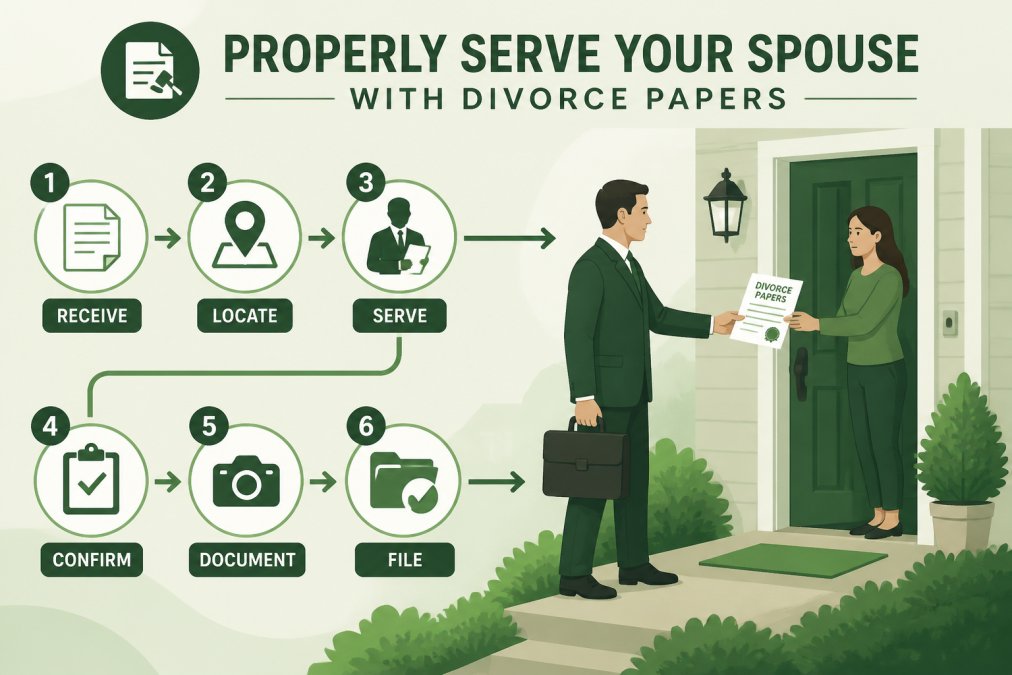
Michigan law allows several methods of service. Personal service, delivering documents directly to your spouse through a process server or sheriff's deputy, is the gold standard and creates the clearest proof of service. If your spouse is cooperative, they can accept service voluntarily by signing an acknowledgment, avoiding process server costs. Certified mail with return receipt is another option when your spouse's location is known and they're unlikely to refuse delivery.
When Your Spouse Cannot Be Located
Service by publication becomes necessary when your spouse's location is unknown or they're evading service. This involves publishing notice of the divorce in a local newspaper for a specified period, typically four weeks in Michigan. You must file an affidavit describing your efforts to locate your spouse and why service by publication is appropriate. Once the notice is published for the required period, you file an affidavit of service documenting publication dates, and the response window begins.
3. Use Mediation to Reach an Agreement
Mediation offers a structured alternative when your spouse is unwilling to sign but may be open to negotiation. A neutral third party facilitates discussion between you and your spouse to reach mutually acceptable agreements on divorce terms.

Mediation reduces legal costs, maintains privacy, and often preserves relationships, particularly important if children are involved. Unlike litigation, mediation is confidential and what's discussed cannot be used against you in court if mediation fails.
The mediator doesn't make decisions but helps both parties communicate effectively, identify common ground, and explore creative solutions. The process typically begins with an initial session where each party outlines their position, followed by sessions focusing on specific issues like property division, spousal support, and custody arrangements.
If mediation succeeds, you'll reach a settlement agreement that's formalized into a divorce decree through the court. Even if mediation doesn't resolve every issue, it often narrows disagreements significantly, reducing the scope of subsequent litigation.
4. File for a Contested Divorce and Let the Court Decide
When your spouse refuses to cooperate and mediation isn't viable, a contested divorce allows the court to decide disputed issues. You file your petition and proceed through litigation, presenting evidence and arguments to the judge who will determine property division, spousal support, and other contested matters.
Filing requires completing the same initial paperwork as an uncontested case. The difference is that your spouse files a response contesting your proposals rather than accepting them. Once both parties have filed their positions, discovery begins, the process where each side requests documents and information from the other: bank statements, tax returns, business records, communications. You'll also exchange interrogatories and may conduct depositions.
Discovery can be time-consuming and expensive, but it's essential for building your case. As discovery proceeds, opportunities for settlement discussions often emerge. Many contested divorces settle before trial once both parties understand the strength of the other's position and likely court outcome.
If settlement doesn't occur, your case proceeds to trial. Both parties present evidence, call witnesses, and argue their positions to the judge, who then issues a ruling on all contested issues, creating a binding divorce decree.
5. Explore Legal Separation as an Alternative
Legal separation provides an alternative when your spouse won't sign divorce papers but you need legal clarity on financial and custody arrangements. A legal separation is a court-ordered agreement addressing the same issues as divorce, property division, spousal support, child custody, but it doesn't dissolve the marriage.
Get Your Free Consultation Now →
Some people choose legal separation for religious reasons, to maintain spousal health insurance coverage, or because they're uncertain about divorce but need legal protection. The legal separation process is nearly identical to divorce: you file a petition, serve your spouse, and either reach agreement or litigate contested issues.
The significant difference is the end result. A legal separation doesn't end the marriage, so you remain legally married. However, you have a court order clarifying financial obligations, custody arrangements, and property division, providing the same legal protections as divorce. If you later decide to convert a legal separation to a divorce, the process is typically simpler, requiring only a motion to convert if both parties agree.
6. Hire an Attorney to Navigate the Process
Hiring an experienced family law attorney transforms your ability to handle divorce without spouse signature. An attorney manages service of process, files all required documents correctly, navigates court procedures, and advocates for your interests throughout the process.
When facing a non-cooperative spouse, attorney representation becomes particularly valuable. Your attorney knows which service method is most appropriate, can arrange professional process servers, and understands default judgment procedures. They ensure every document meets court requirements and deadlines are met.
An attorney also provides critical guidance on strategy: Should you pursue default divorce or contested litigation? Is mediation worth attempting? What's a realistic outcome given your circumstances? For complex cases involving substantial assets, business interests, or child custody disputes, attorney representation is nearly essential.
Coppins Law Group, PLLC offers free initial consultations to discuss your specific situation. Costs vary based on case complexity, but competent legal representation often saves money by avoiding costly mistakes and protecting your interests in court.
Managing the Emotional and Financial Toll
Divorce without spouse signature is emotionally demanding. Your spouse's refusal to cooperate often reflects deeper conflict, hurt, or anger. Acknowledge this emotional reality, divorce is a significant life transition, and resistance intensifies stress and uncertainty. Many people benefit from therapy or counseling to process emotions and maintain perspective.
The financial toll is equally significant. Court fees, attorney costs, process service expenses, and mediator fees accumulate. Budget realistically and understand that contested divorce is expensive. Consider the cost-benefit analysis of different approaches: a default divorce or mediated settlement is significantly less expensive than full litigation.
| Approach | Timeline | Cooperation Required |
|---|---|---|
| Default Divorce | 2-4 months | Minimal after service |
| Mediation | 1-3 months | Both parties willing to discuss |
| Contested Litigation | 6-18 months | None; court decides |
| Legal Separation | 2-6 months | Depends on cooperation |
Protect your mental health throughout the process. Maintain connections with supportive friends and family. Avoid using your children as messengers or emotional support. Keep communication with your spouse focused on legal and financial matters, not personal grievances. Document everything related to your divorce, service attempts, communications, financial transactions, and agreements. This documentation supports your legal case and protects you if disputes arise later.
Remember that divorce without spouse signature is a marathon, not a sprint. The process takes time, involves setbacks, and requires patience. But it's achievable. Thousands of people navigate this situation annually using the legal tools available through the courts.
Navigating divorce when your spouse refuses to sign requires understanding your legal options and choosing the approach that fits your circumstances. Whether you pursue default divorce, mediation, contested litigation, or legal separation, the path forward exists, even without your spouse's cooperation. Coppins Law Group, PLLC provides experienced guidance through this process, offering steady representation and strategic counsel to protect your rights and help you move forward. Contact us today for a free initial consultation to discuss your specific situation and explore which approach makes sense for your case.
Frequently Asked Questions
Can my spouse divorce me without my signature?
Yes. If you refuse to sign divorce papers, your spouse can pursue a default judgment in court. After properly serving you with the petition for dissolution and allowing the response window to pass, the court can grant a divorce decree without your signature. This is called a default divorce. The court will make decisions about property division, spousal support, and child custody based on state law and evidence presented.
What is the default divorce process in Michigan?
The default divorce process begins when one spouse files a petition for dissolution and serves the other spouse with summons and court documents. The respondent has a set response window (typically 21 days) to file a response. If they fail to respond, the petitioner can request a default judgment from the court. The judge will review the case and issue a divorce decree. This process allows divorce to proceed even without the respondent's cooperation or signature.
How do you serve divorce papers to a spouse who is avoiding service?
If your spouse is avoiding service, you have several options. A professional process server can attempt service at their home, workplace, or last known address. If standard service fails, you can request service by publication, which involves publishing the notice in a local newspaper. You can also use certified mail or hire a private investigator to locate your spouse. Each method requires filing an affidavit of service with the court to prove due process has been followed.
What are the benefits of divorce mediation when my spouse refuses to cooperate?
Mediation offers several advantages even when a spouse initially refuses to sign. A neutral mediator can facilitate discussion about property division, spousal support, and child custody in a structured setting. Mediation is typically faster and less expensive than litigation. It gives both parties control over the outcome rather than leaving decisions to a judge. Many couples who are initially uncooperative find mediation helps them reach fair agreements, avoiding the need for a contested court hearing.
Should I hire an attorney or try a DIY divorce without my spouse's signature?
A DIY divorce works only for uncontested cases where both spouses cooperate. If your spouse refuses to sign, you need an attorney. An experienced family law attorney can navigate default judgment procedures, ensure proper service of process, represent you in court, and protect your interests regarding assets and custody. While attorney fees are higher than DIY services, professional representation is essential when facing a non-cooperative spouse and helps avoid costly mistakes.