 how-to
7 Ways to Reduce Divorce Legal Costs Before Trial
Last Updated: October 24, 2026
Quick Summary
You can reduce divorce legal costs by controlling the two things that drive them: time and conflict. Settle instead of going to trial, try mediation first, batch your questions to your attorney, organize your documents early, and set a budget you discuss openly.
- Most firms bill attorney time in tenths of an hour, so a 3-minute call may still cost 0.1 hour.
- A retainer is an upfront deposit billed against as work is done, not a flat fee.
- Mediation usually costs less than litigation because it replaces courtroom hours with scheduled negotiation sessions.
- Organizing your financial documents before you hire counsel cuts attorney hours more than almost anything else.
- Handle paperwork and information gathering yourself, but call a lawyer for deadlines, court filings, and legal rights.
Table of Contents
- Where Divorce Legal Costs Actually Come From
- How to Prepare for a Divorce Lawyer Consultation
- Questions to Ask a Divorce Attorney About Fees
- How to Organize Divorce Documents Before You Hire Counsel
- Divorce Mediation Costs vs. Litigation: What to Expect
- 7 Ways to Reduce Divorce Legal Costs at Every Stage
- When to Handle a Task Yourself and When to Call a Lawyer
- Get Your Free Consultation and Build a Cost-Smart Plan
- Frequently Asked Questions
Where Divorce Legal Costs Actually Come From
Divorce legal costs are the total fees and expenses a person pays to legally end a marriage, and they usually come from four places: attorney time, court filing fees, document and service costs, and the cost of disputes that stretch the case out. At Coppins Law Group, PLLC, we tell clients the same thing on day one: the fastest way to reduce these costs is to understand where they start.
Divorce legal costs are driven by time and conflict.
Here is the breakdown most people never see until the bill arrives:
- Attorney time: hourly work, billed in small increments. Most firms bill in tenths of an hour (6-minute increments), so a 3-minute call may still cost 0.1 hour. Rates vary widely by market and experience; court appearances and trial days often bill at the higher end.
- Court costs: filing fees and administrative charges set by the court. A divorce filing fee varies depending on the state and county; motion fees and other administrative charges add to that.
- Service of process: delivering the divorce papers to your spouse. Professional service varies in cost; if a process server must make multiple attempts or locate a spouse, the fee rises.
Retainers and billing mechanics. A retainer is an upfront deposit a lawyer holds and bills against as work is done.
Sample scenarios (illustrative only; actual costs vary by jurisdiction, complexity, and attorney rates):
- Uncontested, low-conflict divorce with no children and modest assets: attorney time for document preparation and a brief hearing, filing fee, and service. Costs for an uncontested, low-conflict divorce with no children and modest assets involve attorney time for document preparation and a brief hearing, filing fee, and service.
- Contested divorce with children and a house, resolved through mediation: attorney time for negotiation, mediation preparation, and document review; mediator fees (split between spouses); filing and service costs. Costs for a contested divorce with children and a house, resolved through mediation, involve attorney time for negotiation, mediation preparation, and document review; mediator fees; filing and service costs.
- High-conflict divorce with business valuation and trial: attorney time for discovery, motions, expert coordination, and trial; expert fees; court costs. Costs for a high-conflict divorce with business valuation and trial involve attorney time for discovery, motions, expert coordination, and trial; expert fees; court costs.
These figures are not quotes. They are ranges to help you ask better questions.
For a closer look at what these pieces add up to in this state, see our guide on how much a divorce costs in Michigan.
The lesson is simple. Costs come from time and friction. Control both, and you control the bill.
How to Prepare for a Divorce Lawyer Consultation
The best way to prepare for a divorce lawyer consultation is to arrive with a written summary of your situation, a list of your questions, and your financial documents in order.
Most consultations follow the same pattern. You describe the marriage, the assets, the children, and what you want. The attorney explains the process and possible outcomes.
You can make that hour count:
- Write a one-page timeline of the marriage and the separation.
- List income, debts, accounts, and property.
- Bring your top five questions about fees and process.
- Note any safety concerns or urgent deadlines.
- Ask what the attorney needs from you next.
The goal is not to impress anyone. It is to give the attorney facts, not a story. Facts move a case forward. Stories cost time.
Questions to Ask a Divorce Attorney About Fees
The right questions to ask a divorce attorney about fees are direct ones: what is the hourly rate, what is the retainer, how is time billed, and what happens when the retainer runs out.
A retainer is an upfront deposit a lawyer holds and bills against as work is done. A retainer agreement is the contract that spells out the rate, the deposit, and the billing terms.
Ask these questions in writing:
- What is your hourly rate, and does it change for court time?
- How much is the retainer, and what does it cover?
- How often will I receive bills?
Get the estimate in writing. A good attorney will not promise a fixed number, because no one can predict how a spouse will behave.
How to Organize Divorce Documents Before You Hire Counsel
Organizing divorce documents before you hire counsel means building one clear file of your financial life: income, accounts, debts, property, and expenses, sorted and labeled.
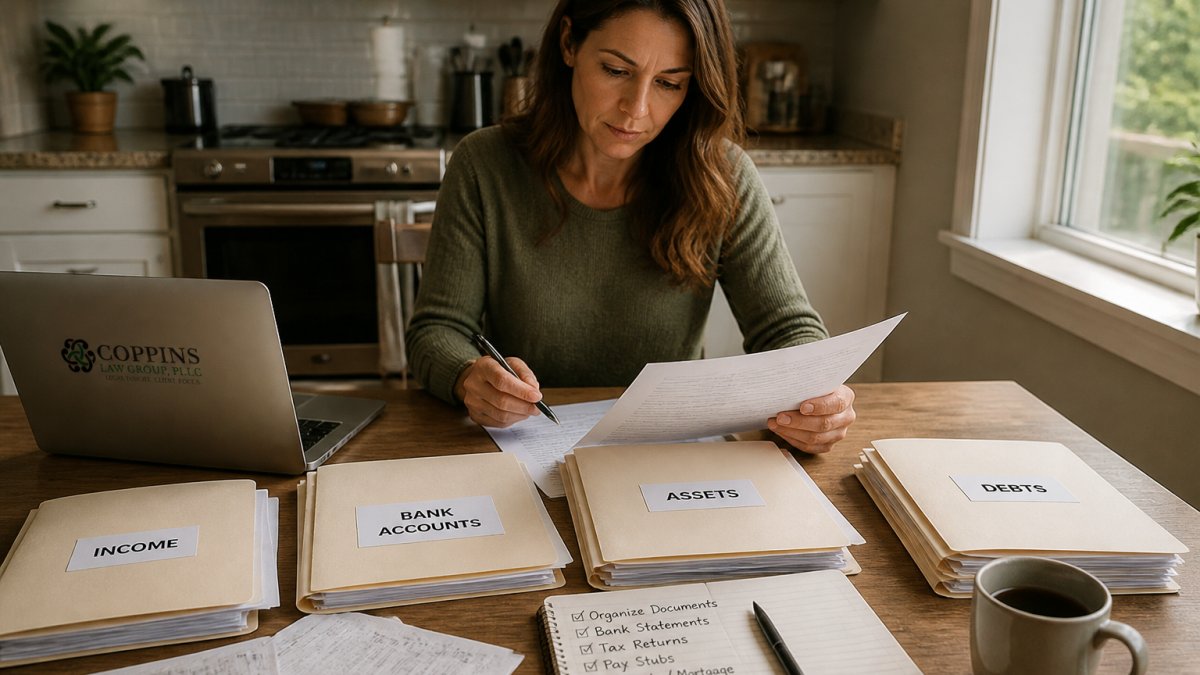
Here is a simple system we recommend to clients:
- Income: recent pay stubs and tax returns
- Accounts: bank, retirement, and investment statements
- Debts: credit cards, loans, and mortgage statements
- Property: deeds, titles, and recent appraisals
Label each folder by category. Scan what you can. Bring copies, not originals.
A common mistake is handing over a shoebox of loose papers. Your attorney then bills time to sort it. Do that sorting yourself and the savings are real.
Divorce Mediation Costs vs. Litigation: What to Expect
Divorce mediation costs are usually lower than litigation costs because mediation replaces courtroom hours with scheduled negotiation sessions.
Get Your Free Consultation Now →
Here is how the two paths compare:
| Factor | Mediation | Litigation |
|---|---|---|
| Main cost driver | Session hours | Attorney hours plus court time |
| Timeline | Usually shorter | Often longer |
| Control over outcome | Both spouses decide | A judge decides |
| Court appearances | Rare | Common |
| Best for | Willing spouses | High conflict or hidden assets |
For a detailed cost comparison, read our breakdown of divorce mediation versus litigation. It walks through what each path demands from your budget.
Mediation is not always right. If your spouse hides assets or refuses to negotiate, litigation may be the only path.
7 Ways to Reduce Divorce Legal Costs at Every Stage
You can reduce divorce legal costs at every stage by controlling the two things that drive them: time and conflict. The steps below work from the first phone call through the final settlement.
- Settle instead of going to trial. A negotiated settlement avoids the heaviest courtroom hours. Most cases resolve this way.
- Try mediation first. A neutral mediator can settle disputes in a few sessions instead of months of filings.
- Communicate efficiently with your attorney. Batch your questions into one email instead of ten calls.
- Organize your documents early. Complete files mean fewer billable hours spent chasing records.
- Set a budget and discuss it openly. Ask your attorney to flag when costs are rising.
- Avoid unnecessary disputes. Fight over what matters. Let the small items go.
- Use virtual meetings when offered. They cut travel time and can lower session costs.
That last point deserves attention. Virtual sessions remove drive time and scheduling friction. Our article on the benefits of virtual divorce mediation sessions explains how the format works and where it fits.
A common mistake is treating every disagreement as a battle. Each one adds hours. Pick your fights and you protect your budget.
When to Handle a Task Yourself and When to Call a Lawyer
Handle a task yourself when it is paperwork, organization, or information gathering.
Ask three questions:
- Does a missed deadline cost me rights? If yes, call a lawyer.
- Does this involve a legal document I must sign or file? If yes, get counsel.
- Am I unsure what the law requires? If yes, ask before you act.
Tasks that are usually safe to handle yourself (with careful instructions):
- Gathering financial records: pay stubs, bank statements, tax returns, retirement account statements, mortgage statements, and credit card statements.
- Creating a timeline of the marriage, separation, and key events.
- Drafting a preliminary inventory of assets and debts (your attorney should review it).
- Organizing documents into labeled folders, digital or physical.
Tasks that usually require a lawyer:
- Signing a settlement agreement or separation agreement.
- Responding to a motion or discovery request.
- Negotiating directly with a hostile spouse or opposing counsel.
- Anything involving a court deadline or filing.
Affordable legal help options. If you cannot afford full representation, consider these pathways:
- Limited-scope representation (unbundled services): You hire a lawyer for specific tasks, such as reviewing a settlement agreement or coaching you for a hearing, while you handle the rest. Ask whether the firm offers this and what the fee structure is.
- Legal aid: Nonprofit legal aid organizations provide free or low-cost help to eligible clients based on income and case type. Eligibility varies; contact your local legal aid office or use the Legal Services Corporation's directory to find providers.
- Court self-help centers: Many courts operate self-help centers that offer forms, instructions, and sometimes brief advice for people representing themselves. These are not a substitute for legal advice, but they can help you avoid procedural mistakes.
- Pro bono programs: Bar associations and volunteer lawyer programs sometimes match low-income clients with attorneys willing to take cases without charge.
Weighing the trade-off. Doing a task yourself saves money only if you do it correctly.
Watch out: agreeing to terms in a text message or email can create problems later.
Our team put together a list of the 5 costly divorce mistakes to avoid.
Get Your Free Consultation and Build a Cost-Smart Plan
A cost-smart plan starts with clear information and a lawyer who explains the numbers before the work begins.
Here is what to expect from us:
- A free initial consultation to review your situation
- Clear answers about fees and what drives them
- Steady guidance through each stage of the case
- Strong advocacy if your case heads to court
We serve clients across Michigan, and we are trial-prepared when settlement talks stall. You get straight answers, not vague estimates.
If you want to understand your options before you commit to anything, start with a conversation. Our family law attorney page explains how to reach us and what the free consultation covers.
Frequently Asked Questions
How can I reduce legal fees during a divorce?
Focus on three areas: preparation, communication, and settlement. Organize all financial documents before your first meeting so your attorney spends less time gathering information. Ask for an itemized fee schedule and request monthly billing statements. Choose mediation or collaborative divorce over litigation when possible. Avoid using your lawyer as a therapist, and batch your questions into scheduled emails rather than calling daily. These steps can meaningfully reduce divorce legal costs without sacrificing your rights.
Can mediation help lower the cost of divorce?
Yes. Divorce mediation costs are typically a fraction of litigation expenses because you and your spouse split the mediator's fee and avoid multiple court appearances. Mediation usually requires fewer billable hours from your attorney, who reviews the settlement rather than building a full trial case. Many couples resolve property division, child custody, and support in a few sessions. Mediation works best when both parties are willing to negotiate in good faith and full financial disclosure is provided.
What documents should I organize before hiring a divorce attorney?
Gather recent tax returns, pay stubs, bank and investment statements, retirement account summaries, mortgage and loan documents, property deeds, vehicle titles, credit card statements, and any prenuptial or postnuptial agreements. Also collect records of child-related expenses and proof of separate property. Having these ready at your first consultation lets your attorney give you a realistic cost estimate and strategy, and it reduces billable hours spent on document collection.
Is an uncontested divorce less expensive than a contested divorce?
Yes. An uncontested divorce, where both spouses agree on all terms, requires far fewer attorney hours and avoids court hearings and discovery. A contested divorce involving disputes over property, custody, or support can multiply legal fees through motions, depositions, and trial preparation. If you can resolve major issues through negotiation or mediation, you move closer to an uncontested or settlement-based divorce, which is one of the most effective ways to reduce divorce legal costs.
Divorce is stressful enough without wondering what each phone call costs. The right plan, the right documents, and the right attorney can keep both your case and your budget on track. Get started with Coppins Law Group, PLLC and build a cost-smart plan for your divorce.