 how-to guide
How to Challenge a Macomb County DUI: Step-by-Step Guide
Table of Contents
- Understanding DUI and OWI Charges in Macomb County
- What to Do Immediately After a DUI Arrest in Macomb County
- DUI Penalties in Macomb County: First, Second, and Subsequent Offenses
- Field Sobriety Test Challenges in Michigan: Key Defense Tactics
- How to Challenge a Macomb County DUI in Court: Evidence and Motions
- Understanding the DUI Court Process in Macomb County
- Working with a Macomb County DUI Lawyer: What to Expect
- Expungement and License Restoration After a Macomb County DUI
- Frequently Asked Questions
How to Challenge a Macomb County DUI: Step-by-Step Guide
Last Updated: July 22, 2026
If you've been arrested for a DUI in Macomb County, Michigan, understanding how to challenge macomb county dui charges is critical to protecting your rights and future. The difference between accepting a conviction and mounting a strong defense can fundamentally alter your life, affecting your career, driving privileges, and freedom. This guide walks you through essential steps for challenging a DUI in Macomb County, from arrest through trial, including evidence-gathering tactics and legal motions that have proven effective in similar cases.
Understanding DUI and OWI Charges in Macomb County
Michigan law distinguishes between several alcohol and drug-related driving offenses, each carrying different penalties and defense opportunities.
Operating While Intoxicated (OWI) is the most serious charge, requiring proof that your blood alcohol content (BAC) was 0.08% or higher, or that you were otherwise impaired. OWI carries mandatory jail time, license suspension, and substantial fines even for first offenses. Operating While Visibly Impaired (OWVI) doesn't require a specific BAC; prosecutors only need to prove signs of impairment like slurred speech or failed field sobriety tests. Operating With Presence of Drugs (OWPD) applies when charged with driving under the influence of Schedule 1 drugs, marijuana, or prescription medications and is particularly vulnerable to challenge because prosecutors must prove the drug impaired your driving, not merely that it was present in your system.
Super Drunk (High BAC), charged when your BAC is 0.17% or higher, is a felony-level offense triggering mandatory ignition interlock installation, longer license suspension, and increased jail time.
What to Do Immediately After a DUI Arrest in Macomb County
Your actions following a traffic stop significantly impact your defense.
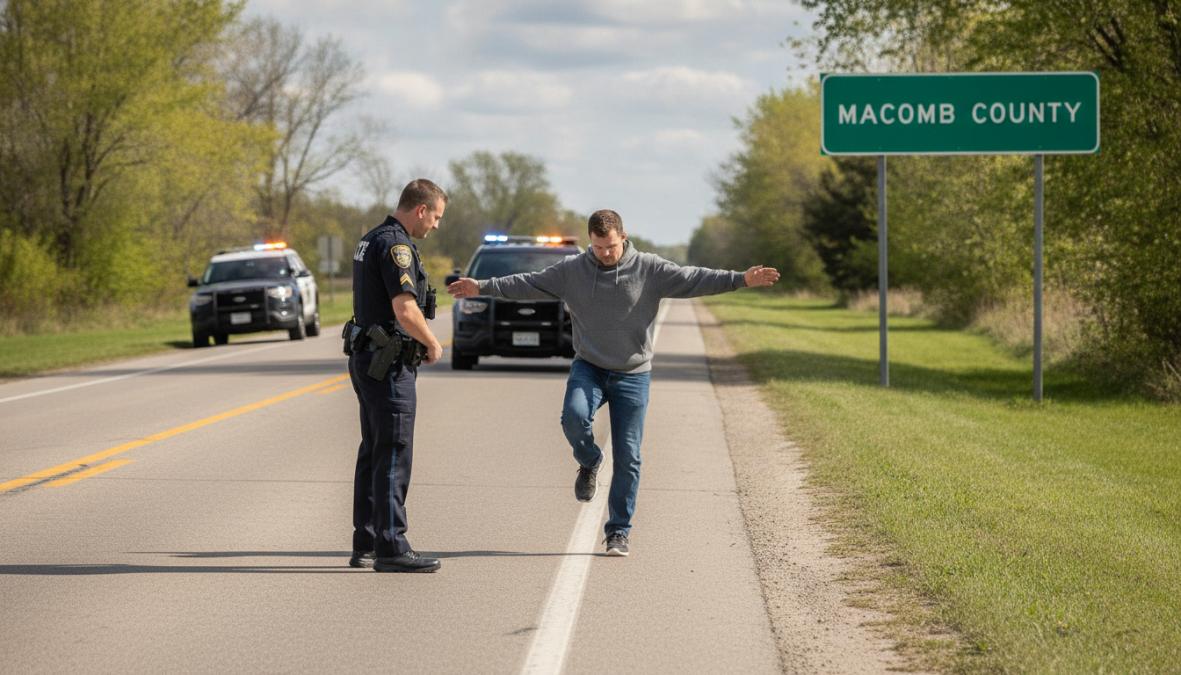
Traffic Stop and Field Sobriety Tests
When an officer initiates a traffic stop, they must have reasonable suspicion that you've committed a traffic violation or crime. If the stop was pretextual, made without reasonable suspicion, any evidence gathered is suppressible and inadmissible in court.
You have the right to refuse field sobriety tests. Refusing does not result in automatic license suspension and eliminates the officer's ability to document "failed" tests in their report. Many people believe they must comply with FSTs to avoid appearing uncooperative, but this misconception costs defendants their best defense opportunity. FSTs are inherently unreliable, designed to be failed, and environmental factors like uneven pavement, poor lighting, and wind all undermine their validity.
(/macomb-county-inmate-lookup/)]If you perform FSTs, request a copy of any video recording, dashcam or body camera footage is crucial evidence for your defense.
Breathalyzer and Blood Test Rights
After field sobriety tests, the officer will likely request a preliminary breath test (PBT) at the roadside. You have the right to refuse this test without automatic license suspension.
If arrested and taken to the police station or hospital, you'll be asked to submit to a chemical test. Michigan's implied consent law means refusing a chemical test results in automatic license suspension for one year (or two years for a second refusal within seven years), regardless of conviction. However, refusing prevents the prosecutor from presenting chemical test evidence, which is often their strongest evidence.
Request the maintenance records for the breathalyzer used in your case. Breathalyzers must be calibrated regularly and kept in proper working condition. If the device wasn't calibrated within the required timeframe, or if records show malfunction, the test results are inadmissible.
DUI Penalties in Macomb County: First, Second, and Subsequent Offenses
Understanding the penalties you're facing helps you appreciate the importance of mounting a vigorous defense.
First OWI offense carries a mandatory minimum of 6 months probation, up to 180 days in jail, and fines ranging from $250 to $1,000. Your driver's license is suspended for a minimum of 6 months.
Second OWI offense within 7 years escalates dramatically: mandatory 5 days to 1 year in jail, fines of $500 to $5,000, and a 1-year license suspension. The court may order you to wear a SCRAM device (Secure Continuous Remote Alcohol Monitoring), which detects alcohol consumption through your skin 24/7.
Third OWI offense within 10 years becomes a felony, punishable by 30 days to 5 years in prison, fines up to $5,000, and a 1-year license suspension. Felony conviction carries permanent collateral consequences: loss of voting rights, ineligibility for certain professional licenses, and difficulty securing employment.
Super Drunk (High BAC) convictions carry enhanced penalties at every level. First offense: mandatory 2 days to 6 months in jail and mandatory ignition interlock installation.
License Suspension and Ignition Interlock Requirements
Beyond criminal penalties, your driving privileges face immediate and long-term consequences. If you refused a chemical test, your license is automatically suspended for one year. If you submitted to a test and the BAC result was 0.08% or higher, your license is suspended for 6 months on a first offense.
An ignition interlock device is a breathalyzer installed in your vehicle's dashboard. You must blow into it before the engine starts, and it randomly requires breath samples while driving. Installation costs $100-$200, and monthly monitoring fees run $50-$100.
Challenging the DUI conviction prevents these collateral consequences.
Field Sobriety Test Challenges in Michigan: Key Defense Tactics
Field sobriety tests are the most vulnerable evidence in a DUI case. They're scientifically unreliable, subjective, and heavily influenced by factors unrelated to impairment.
Reliability and Administration Issues
The National Highway Traffic Safety Administration (NHTSA) recognizes three standardized FSTs: the horizontal gaze nystagmus (HGN) test, the walk-and-turn test, and the one-leg stand test. Even NHTSA acknowledges these tests are only 65-77% accurate when administered perfectly under ideal conditions. In real-world traffic stops, accuracy plummets.
The HGN test measures involuntary eye jerking as your eyes follow a moving object. However, nystagmus occurs naturally in approximately 35% of the population due to neurological conditions, eye problems, or medications. The walk-and-turn test requires you to walk nine steps heel-to-toe, turn, and walk back. Officers watch for eight "clues" of impairment, but all of these behaviors are normal for sober people, especially those who are anxious, wearing improper footwear, or standing on uneven pavement. The one-leg stand test requires you to stand on one leg while counting aloud for 30 seconds. These behaviors are entirely consistent with sobriety, particularly for people over 65, people with balance disorders, or anyone wearing dress shoes on an uneven surface.
When challenging FST evidence, focus on three areas: officer training and certification, test administration procedures, and environmental factors. Did the officer follow NHTSA guidelines exactly? Were the tests conducted on a level, well-lit surface? Was there wind affecting balance?
Medical and Environmental Factors
Many medical conditions mimic signs of impairment. Inner ear disorders, neurological conditions, diabetes, and arthritis all affect balance and coordination. Medications, including common prescriptions for blood pressure, anxiety, and sleep, impair balance and cause dizziness. If you have any underlying medical condition or take any medication, this is a powerful FST defense.
Environmental factors also undermine FST reliability. Uneven pavement, gravel, or grass surfaces make the walk-and-turn test nearly impossible. Poor lighting, a common scenario during nighttime stops, prevents proper balance. Wind affects balance during the one-leg stand test.
Request the dashcam or body camera footage from your traffic stop. Video evidence showing the actual conditions, lighting, pavement surface, and weather is extraordinarily powerful.
How to Challenge a Macomb County DUI in Court: Evidence and Motions
Mounting a successful DUI defense requires understanding the specific evidence the prosecution will present and the legal motions available to suppress or exclude that evidence.
Challenging Probable Cause and Search Legality
Every DUI case begins with a traffic stop. The officer must have reasonable suspicion that you committed a traffic violation or crime before initiating the stop. If the stop was pretextual, the entire stop is illegal, and all evidence gathered is suppressed.
Review the police report carefully. What traffic violation did the officer cite? Did you actually commit that violation? Many DUI stops are initiated for minor infractions: weaving slightly, failing to use a turn signal, or driving too slowly. If the violation didn't occur, or if the officer's description contradicts the dash camera footage, the stop lacked reasonable suspicion.
After the stop, the officer must have probable cause to arrest you for DUI. If the officer arrested you based primarily on a failed FST or a borderline breathalyzer result, without other corroborating evidence, the arrest may have lacked probable cause. File a motion to suppress evidence if the traffic stop or arrest lacked legal justification. If successful, the suppressed evidence cannot be used against you, often resulting in case dismissal.
Suppressing Breathalyzer and Blood Test Evidence
Breathalyzer and blood test results are the prosecution's strongest evidence, but they're vulnerable to challenge on multiple grounds.
Breathalyzer challenges: Breathalyzers must be calibrated regularly according to manufacturer specifications. Request the calibration records for the specific device used in your case. If the device wasn't calibrated within the required timeframe (typically every 30 days), the test results are unreliable and should be suppressed. The officer must follow strict procedures when administering the test. The driver must be observed for 15 minutes before the test to ensure no alcohol enters the mouth. If the officer didn't observe you for the full 15 minutes, the test is invalid. Breathalyzers don't measure impairment; they measure the concentration of alcohol in your breath. Acid reflux, GERD, diabetes, and certain medications can produce falsely elevated results.
Blood test challenges: Blood tests are more accurate than breathalyzers but still vulnerable to challenge. The blood sample must be drawn by a qualified phlebotomist using proper sterilization procedures. Request the chain of custody documentation for your blood sample. If the chain of custody is broken, if anyone handled the sample without proper documentation, the test results are unreliable and should be suppressed. The laboratory that tested your blood must follow strict procedures and maintain proper quality control. Request the lab's certification records, proficiency testing results, and the specific technician's training and experience.
Filing Motions to Dismiss
A motion to sever separates multiple charges if you were charged with both DUI and other crimes. A motion for discovery compels the prosecution to provide all evidence in their possession, including police reports, dashcam footage, witness statements, and forensic reports. A motion for independent testing allows you to obtain an independent analysis of blood or breath test results.
Understanding the DUI Court Process in Macomb County
The DUI court process in Macomb County follows a specific sequence, with critical decision points where your attorney can challenge the prosecution's case or negotiate favorable outcomes.
District Court vs. Circuit Court Proceedings
Most DUI cases begin in District Court, which handles misdemeanor charges and preliminary examinations for felony charges. If you're charged with a third OWI offense (felony), your case begins in District Court for a preliminary examination but is transferred to Circuit Court for trial and sentencing. Circuit Court judges typically impose harsher sentences than district judges, and felony convictions carry permanent collateral consequences.
Arraignment, Preliminary Examination, and Trial
Your first court appearance is the arraignment, where you're informed of the charges, advised of your rights, and asked to enter a plea. Do not plead guilty at arraignment. Plead not guilty to preserve your right to challenge the prosecution's evidence and negotiate from a position of strength.
If charged with a felony, a preliminary examination follows within 14 days. The prosecutor presents evidence to establish probable cause that you committed the crime. Your attorney cross-examines prosecution witnesses and challenges the reliability of evidence. The preliminary examination is often the first opportunity to challenge the prosecution's evidence and identify weaknesses.
If your case proceeds to trial, the prosecution must prove every element of the charge beyond a reasonable doubt. Your attorney presents evidence challenging the prosecution's case, cross-examines prosecution witnesses, and may present defense witnesses or expert testimony regarding the unreliability of FSTs or breathalyzer results.
Working with a Macomb County DUI Lawyer: What to Expect
Hiring an experienced DUI attorney is one of the most important decisions you'll make.
Initial Consultation and Case Evaluation
During your initial consultation, your attorney will review the police report, any chemical test results, and the specific charges against you. They'll ask detailed questions about the traffic stop, your interactions with the officer, and any statements you made. A thorough case evaluation identifies the strengths and weaknesses of the prosecution's case. Are there procedural violations in how the arrest was conducted? Were FSTs administered properly? Was the breathalyzer calibrated and operated correctly? Were your rights violated?
Defense Strategy and Representation Options
Your attorney will develop a defense strategy tailored to the specific facts of your case. This might involve challenging the traffic stop's legality, suppressing FST evidence, attacking the reliability of chemical test results, or negotiating a favorable plea deal.
Some DUI cases are best resolved through negotiation. If the prosecution's evidence is strong, your attorney may negotiate a plea to a lesser charge (OWVI instead of OWI, or reckless driving instead of OWVI). Other cases are best resolved through trial. If the prosecution's evidence is weak, if FSTs were administered improperly, the breathalyzer was unreliable, or the traffic stop lacked justification, your attorney may recommend proceeding to trial where the jury can evaluate the evidence and determine guilt beyond a reasonable doubt.
Expungement and License Restoration After a Macomb County DUI
Even if you're convicted, Michigan law provides pathways to expunge your DUI conviction and restore your driving privileges. Expungement removes the conviction from your public record, allowing you to answer truthfully that you have no criminal conviction in most contexts.
Eligibility and Expungement Process
Michigan allows expungement of DUI convictions, but eligibility depends on your offense history and the time elapsed since conviction. For a first OWI offense, you're eligible for expungement five years after sentencing. For a second OWI offense within seven years, you're eligible seven years after sentencing. For a third OWI offense, expungement is not available.
To petition for expungement, you file a motion with the court that sentenced you. The motion must demonstrate that expungement is in the interests of justice. Factors considered include your criminal history, employment prospects, community contributions, and the impact of the conviction on your life. Many judges grant expungement if you've completed probation, maintained a clean record, and demonstrated rehabilitation.
License Restoration Hearings
After your license suspension period expires, you must petition the Secretary of State for license restoration. The petition requires proof that you've completed all court-ordered requirements and that you're a safe driver. At a hearing, you present evidence of rehabilitation: completion of alcohol treatment programs, stable employment, community involvement, and character references.
| Stage | Timeline | Key Action |
|---|---|---|
| Arraignment | Within 72 hours of arrest | Plead not guilty, establish bail |
| Preliminary Examination (felony) | Within 14 days | Challenge probable cause |
| Discovery | Ongoing | Request all prosecution evidence |
| Motions | 30-60 days before trial | File suppression/dismissal motions |
| Trial or Plea | 6-12 months after arrest | Trial or negotiate plea agreement |
| Sentencing | Immediately after conviction | Judge imposes penalties |
| Expungement Eligibility | 5-7 years after sentencing | Petition for record expungement |
| License Restoration | After suspension period | Petition Secretary of State |
Challenging a DUI in Macomb County requires aggressive defense strategy, thorough evidence review, and skilled courtroom advocacy. The stakes are too high to navigate this process alone. At Coppins Law Group, PLLC, we bring over a decade of experience defending DUI cases in Macomb County, with a track record of successful suppression motions, favorable plea negotiations, and jury acquittals. We understand the local court system, the tendencies of specific judges, and the procedural vulnerabilities in DUI prosecutions. From your initial consultation through trial or plea resolution, we provide steady guidance and strategic defense tailored to your case. Get your free consultation with Coppins Law Group, PLLC today and discover how we can protect your rights, your driving privileges, and your future.
Frequently Asked Questions
What are the main differences between DUI and OWI charges in Michigan?
In Michigan, DUI (Driving Under the Influence) and OWI (Operating While Impaired) are often used interchangeably, but OWI is the official legal term. OWI charges include OWVI (Operating While Visibly Impaired) with a BAC of 0.08% or higher, and OWPD (Operating With Presence of Drugs). Super Drunk charges apply when BAC exceeds 0.17%. Understanding these distinctions is crucial when building your defense strategy in Macomb County courts.
Can a Macomb County DUI be dismissed before trial?
Yes, a DUI can potentially be dismissed through motions challenging probable cause, illegal search and seizure, or improper breathalyzer administration. A Macomb County DUI lawyer can file motions to suppress evidence or challenge the traffic stop's legality. If the prosecution's evidence is significantly weakened or constitutional violations occurred, the judge may dismiss the charges. Success depends on the specific circumstances of your arrest and the strength of your defense.
What should I do immediately after a DUI arrest in Macomb County?
After arrest, request legal representation immediately, do not answer questions without your attorney present. You have the right to refuse field sobriety tests, though refusing a breathalyzer carries administrative penalties. Document everything you remember about the traffic stop, the officer's behavior, and any medical conditions affecting your performance. Contact a Macomb County DUI lawyer as soon as possible to protect your rights and begin building your defense strategy.
How can I challenge field sobriety test results in Michigan?
Field sobriety tests are subjective and can be challenged on multiple grounds. Poor administration, inadequate instructions, medical conditions (inner ear problems, arthritis), fatigue, or environmental factors (uneven surfaces, weather) can all affect results. A defense attorney can question the officer's training and certification, examine video evidence, and present expert testimony about test reliability. These challenges are common and effective components of DUI defense strategies in Michigan courts.