 how-to guide
Steps to Take After DUI Arrest in Macomb County
Table of Contents
- Immediate Actions After Your DUI Arrest in Macomb County
- Understanding the DUI Arrest Process in Michigan
- Why Hiring a Macomb County DUI Lawyer Is Critical
- Understanding DUI Penalties in Macomb County
- Your Court Process: Arraignment, Pre-Trial, and Beyond
- The Emotional and Financial Impact of a DUI Arrest
- DUI Expungement in Michigan: Clearing Your Record
- Supporting a Family Member After a DUI Arrest
- Frequently Asked Questions
Last Updated: July 20, 2026
Immediate Actions After Your DUI Arrest in Macomb County
If you've been arrested for driving under the influence in Macomb County, your decisions in the first hours following arrest, what you say, what you refuse, and who you contact, significantly impact your case outcome. This guide covers essential actions from arrest through your first court appearance.
Protect Your Rights During Questioning
The moment police place you under arrest, invoke your right to remain silent. Do not answer questions about where you've been or what you consumed. Request a lawyer explicitly: "I want to speak with an attorney." Once you make this request, police must stop questioning you.
Do not consent to searches of your vehicle or person beyond a pat-down. If they search anyway, note this for your attorney, it may become grounds for suppressing evidence.
Understanding the Booking Process
After arrest, you'll be taken for booking: photographs, fingerprints, personal information, and possibly a DNA sample via buccal swab. You'll be informed of charges against you, typically Michigan's Operating While Impaired (OWI) statute.
At booking, use your phone call to contact family or an attorney. Do not discuss case details over jail phones; these calls are recorded. You'll be held until a bail hearing, typically within 24 hours. Having an attorney present at this hearing is critical to argue for reasonable bail or release on your own recognizance.
Understanding the DUI Arrest Process in Michigan
Michigan law distinguishes between several impaired driving offenses:
Operating While Impaired (OWI) applies when your BAC is 0.08% or higher, or when impaired by drugs or a combination of substances.
Operating While Visibly Impaired (OWVI) applies when your BAC is between 0.04% and 0.07% (or any BAC above zero for drivers under 21), or when you show signs of impairment below the legal limit.
Operating with Presence of Drugs (OWPD) applies when any amount of a Schedule 1 controlled substance is detected, regardless of impairment level.
Super Drunk or High BAC charges apply when your BAC is 0.17% or higher, carrying enhanced penalties including mandatory minimum jail time.
Understanding your specific charge category is the first step toward building a tailored defense strategy.
Field Sobriety Tests and Chemical Testing
Police typically conduct field sobriety tests (FSTs), horizontal gaze nystagmus (HGN), walk-and-turn, and one-leg stand, before administering breath or blood tests. These tests are notoriously unreliable. Nervousness, poor balance, medical conditions, fatigue, and surface conditions can produce false indicators of impairment.
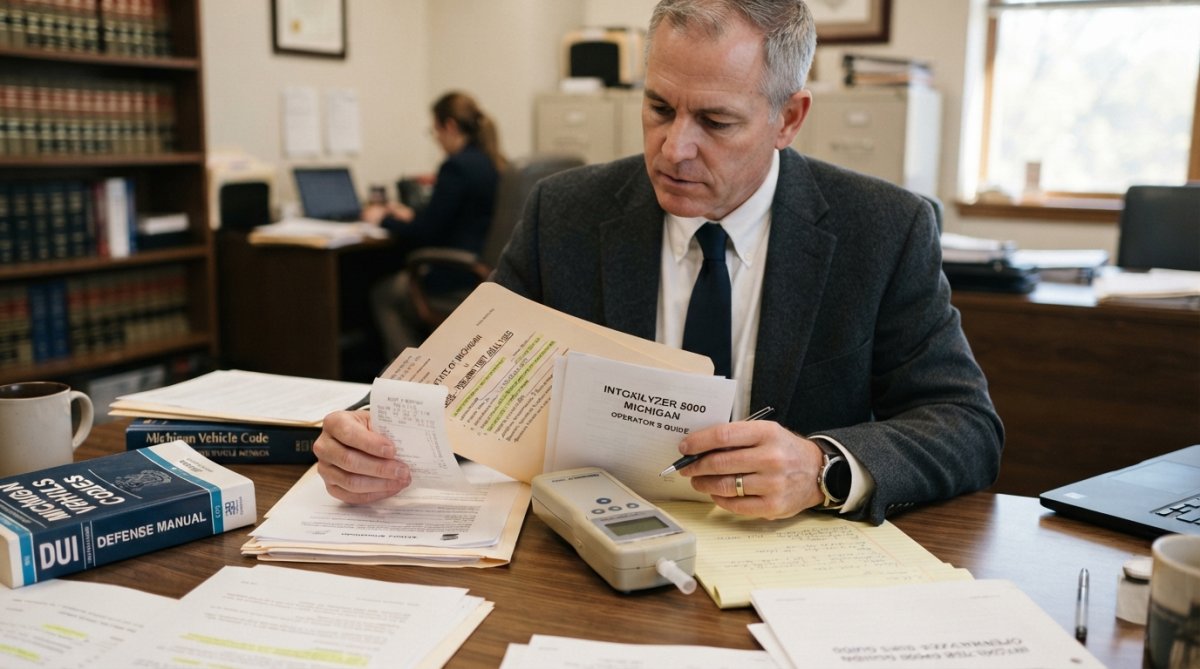
After FSTs, police transport you for a breath test (Breathalyzer) or blood test. Breath testing machines require proper calibration and maintenance. If the machine wasn't calibrated correctly or the officer wasn't properly trained, results can be inaccurate and challengeable.
Your Rights Regarding Breath and Blood Tests
Michigan's "implied consent" law means you've implicitly consented to chemical testing by driving on Michigan roads. However, you can refuse a breath or blood test, though refusal carries serious consequences.
Refusing a breath test results in automatic license suspension for one year on a first offense. However, refusal cannot be used as evidence of guilt in court. A blood test requires either your consent or a warrant. If police draw blood without a warrant and without your consent, that evidence may be suppressed.
Many drivers mistakenly believe refusal helps their case. In reality, it creates additional administrative burden while the prosecution still builds a case using field sobriety tests and officer observations.
Why Hiring a Macomb County DUI Lawyer Is Critical

Representing yourself in a DUI case is a serious mistake. The legal system is complex, evidence rules are technical, and prosecutors are experienced. A Macomb County DUI attorney understands local court procedures, judges' tendencies, and how to challenge chemical testing evidence.
An attorney protects your rights from arrest through trial. They review the police report for inconsistencies, obtain discovery materials, and identify weaknesses. Coppins Law Group, PLLC specializes in DUI and OWI defense throughout Michigan and has handled hundreds of impaired driving cases. We offer a free initial consultation to discuss your case.
An experienced DUI attorney can often negotiate reduced charges or dismissals. Many cases are resolved through plea agreements that minimize penalties and protect driving privileges. Without counsel, you're likely to accept the prosecution's version and plead guilty to charges that could have been reduced or dismissed.
Understanding DUI Penalties in Macomb County
DUI penalties in Michigan are severe and escalate with each offense.
Misdemeanor vs. Felony DUI Charges
A first or second OWI offense is typically charged as a misdemeanor. A first offense carries potential jail time up to 93 days, fines up to $500, mandatory alcohol education programs, probation, and license suspension. A second offense within seven years carries potential jail time up to one year and fines up to $1,000.
A third OWI offense within ten years is charged as a felony, carrying potential prison time up to five years, fines up to $5,000, and permanent license revocation. Operating with high BAC (0.17% or higher) elevates penalties even on a first offense, with mandatory minimum jail time: five days for a first offense, ten days for a second, and 30 days for a third within ten years.
License Suspension and Restoration
Michigan's Secretary of State imposes administrative license suspension separate from court-ordered penalties. A first-offense OWI results in mandatory one-year suspension. Michigan offers a "hardship license" or "restricted license" allowing limited driving for work, school, medical appointments, and alcohol education programs. Your attorney can petition the SOS for a hardship license.
License restoration after suspension requires filing a petition with the Secretary of State. If your case involved a High BAC charge or refusal, restoration is more complex and may require an ignition interlock device (BAIID) installation. An ignition interlock device prevents your vehicle from starting if it detects alcohol on your breath.
Your Court Process: Arraignment, Pre-Trial, and Beyond
After arrest, you'll appear before a judge within 24 hours for an arraignment. At this hearing, you're informed of charges, advised of your rights, and bail is set. Your attorney can argue for reduced bail or release on recognizance.
At arraignment, enter a not guilty plea. This preserves your right to discovery and trial while allowing time for negotiation. After arraignment, discovery begins. The prosecution must provide police reports, test results, and witness statements. Your attorney reviews this material to identify weaknesses.
Pre-trial conferences follow, where your attorney and prosecutor discuss the case. Many cases are resolved at this stage through plea negotiations. If no agreement is reached, the case proceeds to trial. At trial, the prosecution must prove guilt beyond a reasonable doubt. Your attorney can cross-examine the officer and the technician who administered the breath test.
The entire process typically takes several months from arrest to resolution.
The Emotional and Financial Impact of a DUI Arrest
A DUI arrest creates stress extending far beyond the courtroom. Many people experience anxiety, depression, and shame. Seeking support from a counselor or therapist can help you manage anxiety about the legal process.
Managing Costs Beyond Legal Fees
A DUI arrest generates costs beyond attorney fees: court costs, fines, alcohol education programs (several hundred dollars), ignition interlock device installation ($100-$300) and monthly monitoring ($50-$100), and increased insurance premiums. Insurance rates can double or triple and last three to five years or longer.
Create a budget accounting for all costs. Discuss payment plans with your attorney if legal fees are a concern.
Impact on Employment and Professional Licenses
A DUI conviction can damage employment prospects. Employers conducting background checks will see the conviction. If you work in healthcare, law, education, or other regulated professions, a DUI conviction may trigger professional license review or disciplinary action.
If your career is at risk, discuss this with your attorney. Some cases can be resolved in ways that minimize professional consequences.
DUI Expungement in Michigan: Clearing Your Record
Michigan law allows expungement (record clearing) of certain DUI convictions under specific circumstances. A first-offense OWI can be expunged if five years have passed since sentencing and you've completed all terms. A second or third OWI within seven years cannot be expunged. Charges that are dismissed or result in acquittal can be expunged immediately.
Expungement is not automatic; you must petition the court. If granted, the conviction is removed from public databases, eliminating the conviction from background checks and allowing you to pursue employment and housing without the DUI stigma. However, expungement does not restore driving privileges or reverse license suspension.
Supporting a Family Member After a DUI Arrest
If a family member has been arrested for DUI, your first action should be helping them secure legal representation. Attend court hearings when possible and help them understand the process. Encourage them to follow all court orders and maintain communication with their attorney.
How to Help Without Enabling
Supporting someone arrested for DUI does not mean excusing the behavior. A DUI arrest is a wake-up call. Your support should encourage positive change, not enable continued problematic behavior.
Do not offer to drive them to bars or social events where alcohol will be present. Do not minimize the seriousness of the charge. Instead, encourage them to take the arrest seriously and consider whether their relationship with alcohol needs to change. If substance abuse is an underlying issue, encourage professional treatment.
A DUI arrest in Macomb County is a serious matter with immediate and long-term consequences. Protecting your rights, securing legal representation, and understanding the process determine your outcome. Coppins Law Group, PLLC offers experienced DUI defense with a track record of reducing charges, protecting driving privileges, and guiding clients through the court process. Contact us today for a free initial consultation to discuss your case and explore your legal options.
| Stage | Timeline | Key Action |
|---|---|---|
| Arrest & Booking | 0-6 hours | Invoke right to remain silent; request attorney; arrange bail |
| Arraignment | Within 24 hours | Enter not guilty plea; discuss bail reduction |
| Discovery | 2-4 weeks | Attorney reviews prosecution evidence; identifies weaknesses |
| Pre-Trial Conference | 4-8 weeks | Negotiate with prosecutor; explore plea options |
| Trial (if needed) | 2-6 months | Present defense; cross-examine witnesses; jury verdict |
| Sentencing | Upon conviction | Judge imposes penalties; probation; license suspension |
| License Restoration | 1+ year | Petition SOS; install ignition interlock if required |
Frequently Asked Questions
What should I do immediately after a DUI arrest in Macomb County?
Immediately after arrest, exercise your right to remain silent and request a lawyer before answering any questions. Do not consent to searches. Provide basic identification but decline to discuss the incident. During booking, you'll be photographed, fingerprinted, and your personal items documented. Contact a Macomb County DUI lawyer as soon as possible to protect your rights and begin building your defense strategy.
How much will a DUI case cost me in Macomb County?
DUI costs vary significantly based on case complexity, charges, and whether your case goes to trial. Beyond attorney fees, expect costs for court fines, license restoration fees, alcohol education programs, and potentially an ignition interlock device. Contact Coppins Law Group, PLLC for a free initial consultation to discuss your specific situation and understand what to expect financially.
What are the penalties for a DUI conviction in Macomb County?
DUI penalties in Macomb County depend on whether it's a first offense and your blood alcohol content (BAC). First-time OWI convictions can include up to 93 days in jail, fines up to $500, license suspension of 30 days to 1 year, and mandatory alcohol education. Super Drunk charges (BAC 0.17% or higher) carry enhanced penalties. A skilled DUI lawyer can work to reduce charges or negotiate plea deals to minimize consequences.
Can I get my DUI expunged in Michigan?
Michigan law allows expungement of certain DUI convictions under specific circumstances. You may be eligible to set aside your conviction if you meet statutory requirements, which depend on your offense type and prior record. DUI expungement in Michigan removes the conviction from public record, helping restore your professional reputation and employment prospects. An experienced attorney can evaluate your eligibility and guide you through the petition process.
References & Resources:
[EXTERNAL_LINK: Michigan Vehicle Code Section 257.625 - Operating While Impaired | legislature.mi.gov]
[EXTERNAL_LINK: Secretary of State License Suspension and Restoration Procedures | sos.state.mi.us]
[EXTERNAL_LINK: National Highway Traffic Safety Administration Field Sobriety Test Standards | nhtsa.gov]